[00:00:00.240] - Gordon
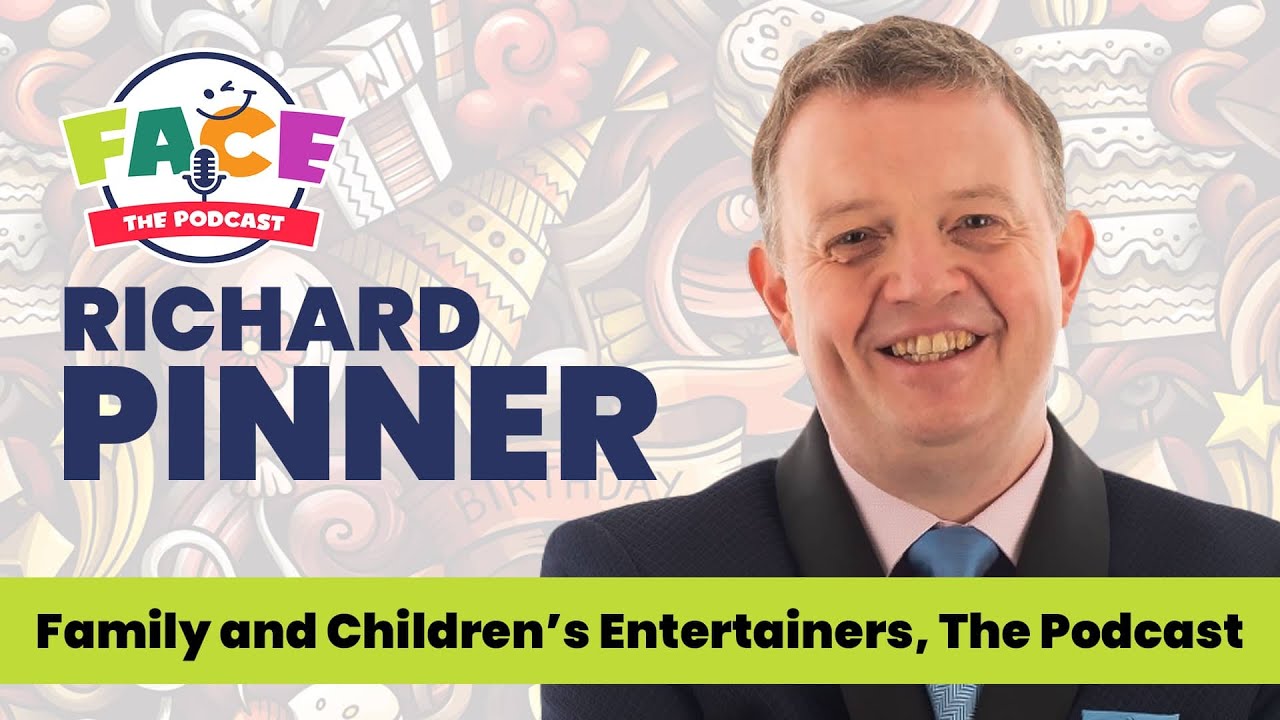
Hello, and welcome to FACE: The Podcast, where we talk to family and children's entertainers about what they do and how they do it. Today we are talking with Richard Pinner, a very well respected magician and entertainer in the UK. He has been the Vice President at The Magic Circle. He's put out a number of effects, one of his most popular being Kid's Cards. He is a second generation entertainer, his father being a magician and children's entertainer before him. We talk about the performance style and costuming in our episode today. We also talk about how he changes his show all the time, and how he chooses material to put into those shows; his ideas for new routines where they come from; his new school show that he's been performing recently. We also talk to him about the worst gig ever, and it's not what you might expect. We even touch on VAT registration. So without further ado, let's talk to our guest for today, Richard Pinner.
[00:01:23.260] - Gordon
Welcome. Thank you so much for joining us on Family And Children's Entertainers: The Podcast. You are a children's entertainer that I have known pretty much my whole professional life, really, because we are a very similar age. In fact, we were born in the same year.
[00:01:44.070] - Richard
By a few days, right? That's all.
[00:01:45.460] - Gordon
I think you're the sixth. Yeah. So there's 23 days between us. Okay. You are older than me though, which is... And wiser, I'm sure you'll say.
[00:01:53.490] - Richard
It shows, right?
[00:01:54.390] - Gordon
Yeah. So you've been doing children's entertainment pretty much all your life. And in fact, you are second generation children's entertainer. So your father, Peter Pinner, was probably one of the first children's entertainers I ever saw at Fairfield Halls.
[00:02:13.000] - Richard
Which is why we share magic words and I don't mind.
[00:02:18.100] - Gordon
Right. Okay. Do you want to talk us through what it was like having a magician as a father? Because you're a father yourself now, so I assume your children are sort of growing up in the same sort of environment.
[00:02:34.920] - Richard
Yes. I'll do mine first because there's only one story on that at this stage. I noticed... Sorry, rather I took a conscious decision. When the older one was it was either two or three certainly very young. And I noticed myself in the kitchen while she was eating, playing with something, making it vanish, just fiddling as we do. And I thought, "Oh, she mustn't think this is real. This is... Not real. She mustn't think it's normal." Because she's learning everything else from us. How to walk, how to talk, how to hold a knife and fork, all that stuff. Mustn't think when you finish with this small object, you can just get rid of it. So they have always known that magic is for shows. And that makes life so much simpler. They know that, it's for shows. Just like everything else fantastical, as they get a bit older, they have more or less belief and more or less wishing to do things. The older one actually did her first public magic trick the other day in a school talent show.
[00:03:35.080] - Gordon
Amazing.
[00:03:35.970] - Richard
I picked Ali Bongo's 'Silk to Rose.' In fact, I made a new one because she has smaller hands.
[00:03:41.698] - Gordon
Yep.
[00:03:42.130] - Richard
So I made her a smaller Silk to Rose, cracking trick, very good trick.
[00:03:46.300] - Gordon
Are you still the cool dad? Because there gets a point when children grow up and it's like, "Oh, he does magic. Ugh."
[00:03:54.060] - Richard
Mine are eight and 10, so I'm still the greatest thing in the world. I know. I've got two daughters. I'm completely stuffed when they become teenagers. I've just got to survive and then they'll love me again when they turn 20. This is what I understand anyway.
[00:04:10.570] - Gordon
Yeah, it's how it went through for me. So I'm sure you'll be the same. So let's go back to your childhood then. You grew up in a house full of magic. Your dad was out doing shows all the time, one of the busiest children's entertainers in the whole of the UK, in fact. So, talk us through how your childhood was growing up with magic.
[00:04:31.680] - Richard
He started in, he turned pro in the late 60s, and I was born in the early 70s. And that boom during the 70s and particularly in the 80s, he and a few others, notably Richard Stuppel, Jack Mays, Terry Herbert, I could probably list a few others if I thought a bit more carefully, pretty much created the genre. It didn't exist in the same way. Sorry, created is too strong, but established, shall we say? The idea of... And of course, the other thing then was, we had all the work. I don't mean Peter Pinner. I mean, there was only really one option for an organised birthday party. It was someone came and did a show and played some games, and that was it. Not like the myriad of options that are available now to parents. So he was doing three or four after school parties a week, and a couple on Saturday and a couple on Sunday. It was a very different industry to it is now. Children weren't as busy as they are now around school. But regarding my childhood within that, every child's childhood is completely normal. So for me, it wasn't much different to a father with a traditional job. Often during the week, he wasn't there for tea time, but he was for breakfast. This is normal. And he wasn't much into the... Apart from the Zodiac Magical Society, he wasn't much into the magic world until I took an interest in my teens. He had lots of magical friends, but he wasn't at The Circle every Monday, until I wanted to start going in my late teens. So I was around it all, but it wasn't being pushed upon me. I had to ask. And he taught me some things. And then I remember the change was I wanted to know how Kevin Ray had just done the brilliant "Out Of This World" based routine. Obviously, Kevin did it actually dealing from three points, top two middles and a bottom. He was dealing to do the suits. So dad showed me "Out Of This World" and said, I'm not going to tell you how it's done, but I'll show you as many times as you want. And that was the beginning of him considering, if you're going to learn this stuff, you don't get that lesson yet. As we all do, we meet a magician, sorry, an amateur magician or a beginning magician, they show you something and you know what the next bit is. I started this with Matilda and a friend the other day. She got given for her 10th birthday a magic set, quite weirdly. But with a lot of the same stuff as was in the Paul Daniels sets that we had. And the same challenges. Understanding the instructions is hard. But then she and her friend would come and show me the trick and I'd show them a better way of doing it, or a tweak, or an improvement. And I think that's how you learn. That's how I learnt. And then, I learnt by osmosis. I saw that show, well those shows, it must have been thousands of times during my teenage years. The shows that you went to at the Fairfield Halls in Croydon. Dad did over 600 performances there. And after your time, when we were teenagers, I would go and be the helper. And there were times when my brother was a bit older, but he didn't really want to get into magic. We were the two helpers. And my father, that was his favourite shows he did over the years, was when we were all doing it, because we knew what he was doing. And I got to know the opening words of any particular routine. I would know where I need to be, what he needs to get. It's a bit like working with a long term assistant. Stuff just happened, which was great for everyone. I know this is a long answer. It meant when I started at 17, or back a stage, because there was no pressure in my family, I wasn't out doing kid's parties at 13 or 14. I didn't do my first proper children's show until I was 17 was my first one. I built my own box table by then as a school GCSE project in woodwork. And it meant when I first started, even though I had no personal experience, I knew a lot of what came next. A child said something, I knew what was funny. When they told me a name, I knew the joke that went with that name because I'd heard it so many times. It was embedded in me, which was a really great start. And then, of course, I had the benefit of my father's reputation. Peter Pinner's son isn't going to be all that bad. I also had him protecting his reputation. He didn't just give me any job that came in that he couldn't do. He would only give me the ones that I could succeed at. Excel would be too much at that early on, but succeed at. It wasn't until my third year that he would, anything came in that I could do, I would. It was an apprenticeship, if you like.
[00:09:39.910] - Gordon
That's very interesting because you got to see the same children's show over and over and over, which a lot of entertainers, the ones that start when they're children, they just don't get that opportunity. I remember, and I spoke to Terry Herbert about this, I remember having a children's entertainer at my eighth birthday party, which was one of the first children's entertainers I'd ever seen. And it turned out to be Howard Peters, I found out later on.
[00:10:10.140] - Richard
Oh, wow.
[00:10:11.140] - Gordon
Which was quite amazing, really, when I found out what he'd done in his career and how children's entertainment was only a very small part of what he did. But I saw that. And I also went to Fairfield Halls and I saw Peter Pinner. But other than that, we had a magician who used to come to my primary school every year and do exactly the same show every year. And I remember most of the show. I remember he had a suitcase on one side of the stage and he took things out of it, performed it, and then he put it into a suitcase on the left hand side of the stage. So he was basically all reset for the next show.
[00:10:54.700] - Richard
That sounds like Peter Eldin.
[00:10:56.590] - Gordon
Oh, I couldn't tell you. It may well have...
[00:10:59.720] - Richard
That attitude.
[00:11:00.280] - Gordon
I've tried really hard to find out, but I have no idea who it was.
[00:11:04.760] - Richard
But let's talk about that because there's a couple of important things there. You said, I saw the same show so many times. I saw the same performer performing a lot of different material many times.
[00:11:18.480] - Gordon
Okay, so your father was one of these entertainers who changed his show a lot, or had different shows for different age groups?
[00:11:26.370] - Richard
Yeah, all that. So the Fairfield Halls example that you gave, that was two shows a day for two weeks, and he would do 10 different shows. So morning and afternoon were exactly the same. And the magic show portion of it was about 25 minutes, I think, I think through the show. There were a lot of big games and there were individual games and there was always an entertaining balloon model in it. And there was always the puppet Cookie the cat to start with, then Doughnut the dog for many, many years. Which meant that I had a lot of material when I started. We don't repeat a trick in a school show for four years.
[00:12:18.070] - Gordon
Okay.
[00:12:19.020] - Richard
And often put particular shows together for that Christmas run. So I can hear and I can even see the entertainers that say, I can hear it. "Children love seeing the same show over and over again. It's like watching the same movie again and again." I disagree. They will enjoy it. And there's bits, for example, the puppet routine has to be in every show, at least the puppet has to appear because they're expecting that. If I see the same children again, I change the show completely. I have a record of every show I've ever done, because I inherited a good system. From show one, sitting over there are the file cards that were used for many, many years, and now it's all digital. Recently, I hosted a wedding, and the bride... Other than planning the wedding, the last time I'd seen her was at her brother's 10th birthday. And in the 90s, I did nine shows for this family and other friends. It was lovely for me, this wedding. I was meeting old clients I hadn't seen for years, and it was four different families. Because, again, that's what it was like back then, wasn't it? You'd do all three siblings, three or four times, and classmates, and cousins, and their classmates. As opposed to the way now quite often have the conversation, "Oh, no one's done magic. Why don't we do that?" Because there's a different activity as opposed to doing it every year. So a different show, completely different show for four years because that's how long it takes them to get through a key stage. And if it is reception to year six, I don't really mind reception seeing the same show in year five. That's a long enough time. It is fascinating when you have schools for that long, when you go back and you hear when they see you and they say, "Oh, are you doing...?" Or "This is the guy that did such and such." It's fascinating to hear which bits they remember from last year's show. It may not be the bits that you thought were the feature.
[00:14:14.560] - Gordon
It's one of the things I ask at the end of a show, I say, "What did you really enjoy?" "What did you enjoy best?" Or "what didn't you like?" Because I'm always intrigued as to what they're going to say because I can never predict it.
[00:14:27.870] - Richard
But do you find patterns, though? Once you've heard the answers about a show once.
[00:14:33.480] - Gordon
So, yes, I have a bunny rabbit in my show, and everyone used to, when I just had the bunny rabbit and did other magic, they used to always say "my favourite bit was when the bunny appeared." I then introduced the drawing board, Axtel's drawing board, and I found I was getting 50-50 . People were enjoying the drawing board and other people were enjoying the bunny rabbit. And that really threw me for a loop because I didn't think I was ever going to be able to top a bunny rabbit. And it's really difficult to not do the drawing board because people get really disappointed if I don't do it. And I understand what you're saying because having a brand new show means that they're seeing fresh material and it's you that they're booking and not the tricks, if you understand what I mean by that.
[00:15:23.490] - Richard
Yeah, but I do appreciate your point about key items. So the puppet routine hasn't really... Do you know what? I think it hasn't changed by many words. I'll bet it has, and I just haven't noticed. But certainly, the core structure of it hasn't changed since before I performed it. It's my father's Doughnut the dog routine, and I do it now with... I did it for a dragon for many years, and now a bunny rabbit. That doesn't really... Apart from the odd thing that happens within the routine, that doesn't change in every single show. They would be disappointed if that didn't happen. The birthday child want it to be... That's one of those things where they want it to be their turn that the jokes are made about them or with them that time. The drawing board, interestingly, it being such a brilliant prop, I wanted to do it. I put it in one Christmas with a pre-recorded routine because I've only got one Ven voice and I was already using that. But I wanted to do it. You'd raved about it for years. I wanted to try it. I had one. It rotted, so I bought... Because I had it for years and didn't use it. Everything went horrible. So I bought another one and loved it. So I tried it, then thought, "I'll just do it for a minute. I'll try it in birthday parties." And dropped it almost immediately because as soon as the prop came out, they knew it was going to happen. There's too many of them in children's magicians' shows.
[00:16:54.910] - Gordon
Yeah.
[00:16:55.170] - Richard
So I didn't do it because I don't want... I have very little in my show that is off the shelf. I have a lot in it that's out of my library, but some bits you can't help because they're made better by other people. But I have got it back in now in my first season science show for schools.
[00:17:19.450] - Gordon
Okay.
[00:17:20.210] - Richard
And there I haven't had it yet. In that environment, no one has said, at least that I've heard, when the prop came out, what it's going to do.
[00:17:31.980] - Gordon
So I want to talk about your school shows a little bit later because that's something that I think is a little bit unique to you in some respects. But we'll come to that. Can I ask, as far as material goes, how much do you do now that is your father's original props or routines? How much do you do now that is stuff you've bought but you've changed completely? And how much stuff is brand new as far as children are concerned because they've come from books or they're old.
[00:18:03.640] - Richard
So I found that my wealth of material dropped as I changed the attitude of the show. So a few years ago, maybe 10 years ago now, I stopped being a 'children's entertainer,' and became 'a magician who has a show for children.' A fundamental shift in my attitude towards the marketplace. And this was not because I'm no longer a children's entertainer, but because I needed to distinguish myself from two actresses and a bubble machine, or a Fairy doing an adventure party, taking them on a treasure hunt, or one of those other myriad of parties that are still great for children, just distinctly not what I do. And about that same time, first of all, on a dare really, I changed around to your way of thinking and did the magic show first. Because we'd spoken about it for many times. My father used to always do the games first and then the magic show after tea. And I can give you all the good reasons why. And then because we'd spoken about it many times, I thought, "I should try it, right? Why not?" And that fitted in quite nicely with this change of becoming a magician who does a show for children. That's the most important part of the party then. So I do it first and I do it when I'm in more control of the timetable; before tea. And I've done it that way ever since. The only time now I've ever done it the other way around is if because something has happened, like half the party isn't there, for example. It's very rare now. And I thought, "Okay, I can't wait for an hour because for your cousins to make it off the M25." It must be just a few times. It's incredibly rare. We still have that option to press play and play some games, those things are all there. When I was 21, so I'd been only doing it four years, I went and did the P&O ships for Reg Webb, and then you needed four different 45 minute shows for children, which is a lot of material.
[00:20:29.310] - Gordon
It is.
[00:20:29.800] - Richard
But I had all that Fairfield Halls stuff, right? For a number of trips I carried and didn't perform, things like Dinky the Dwarf. I've still got my father's Dinky the Dwarf because I love the prop. I've never performed it. It's huge, wooden thing. I'm unlikely to. Every Christmas, I think, "Oh, I could do a pantomime section for the children. That would make sense."
[00:20:53.180] - Gordon
Is this the giant dwarf you're talking about?
[00:20:55.480] - Richard
Yeah. Oh, sorry. A giant dwarf. This is the story of Dinky the Dwarf who lived in a castle alone, of course. He loved all the children, some he may tease. If you'd like to see Dinky, just say "yes, please." And I've never performed it, right? But I've heard it a lot.
[00:21:10.290] - Gordon
It's a great trick.
[00:21:11.370] - Richard
Yeah. Here's an interesting thing. It's an interesting routine. It's not a great trick. So that's one of the reasons I haven't pushed to do it. The magic's not good enough for me now. I want them to gasp. And at least, what I love is when children go, "What the?" And they don't even know the end of that sentence. But they know... And it's quite funny, actually. The kid goes, "What the?" And I say, "You don't even know the end of that." And it gets a laugh out of the parents, which is always a good thing. Children can gasp, and children can wow, and they can spontaneously... They don't know to applaud as a group always, but they'll do reactions they've seen in American sitcoms, because that's their learned behaviour. I don't know how I've drifted onto that now. Sorry. What's the point? What are you actually asking me about?
[00:22:07.010] - Gordon
We were still talking about choices of material.
[00:22:09.610] - Richard
Yeah, hang on. Right. I'm going to go over here. So, I can tell you by looking, if I look back at... Right. That's Christmas pretty much over there. I've got the years written down and the different shows I've done. If I look through my three current favourite shows, bits that are me, me, dad, me, dad, dad, me, dad, me. So there's a good balance, right? In show one. In show two; dad, me, me, dad, me, dad, Ali Bongo, Lossander, you can guess what that routine is. Although I made the prop, so I bought a Lossander table and again had the problem. As soon as I introduced the prop, children knew it was going to float. So I made one. Which is great fun if you're into making things.
[00:23:15.660] - Gordon
You do a lot of making of stuff, which I don't. That's not my bag.
[00:23:22.180] - Richard
So I set myself the challenge. I had two shows that I pretty much liked, and I remembered that I used to have four, and I don't have that material anymore. So I've set about, I've now finished a third show that I like. I'm going to start testing material for show four. It takes ages to settle on a show that can live in a box for the period that you're enjoying doing it or the whole thing can be put in a box and works from between 35 to 50 minutes, because sometimes, you just don't know sometimes. And when I say me on these, I'm not saying completely original material. For example, the opening routine in show three is a glass of liquid production, and that's Pat Page. But I put it in rather than inheriting it. Me, me, dad, dad, dad, me, dad, me. So I'd say it's 50-50 throughout the current favourite shows. And that's not all the material. That's just the ones that are in. There's a whole list here of tricks that haven't got a home currently but are ready, for example. And I know there's... Where are we? If we look at Christmas shows, three two one was pretty much what's become show three. That's when I ran in my different options. There is one year that is a problem child and has been for many cycles. I do it and I think, "Yeah, I'm changing that next time." And that is coming up, I think. If we look back, last time I did it was pre 2017. But I think next year is the problem cycle. Well, next year might be an easy one. I can't remember.
[00:25:08.290] - Gordon
You've got a whole year to wait before that, so you're fine.
[00:25:12.880] - Richard
Yeah, October I'll start thinking about it. And what I tend to do to make my life easier is in general terms, I'll pick currently one of my three, but I'm hoping to make that four, I'll pick one of the three shows and travel with it unless the event means I need to do something different. For example, if there are four or five up until Christmas, then it is a distinctly different show. I haven't written that down. I started making notes recently because I always gravitate for the same material for nursery age or very young reception. But I've never recorded it, really, other than on the event records. But that's a different show. But that comes in a box and I do it for that and it goes back in its box because it's an oddity rather than a norm. And then I'll do one of those three shows until I get bored of it and then swap it round to become the norm unless the event means something else.
[00:26:15.460] - Gordon
Okay. So you will end up with a huge amount of material to pick and choose from when you need to do something specific then, because you're always changing your show, as opposed to other entertainers who have the same show and they do it exactly the same way and they hone it. Like "Three Trick Taylor," the fact that you get three tricks, do them really, really well, earn a living from just those three tricks.
[00:26:44.040] - Richard
Ah, but that's different. This is children's shows. We start talking Cabaret. I'm still polishing because as we've spoken in the past, I'm really generous of Harold Taylor's time and Alan Shaxon's time when they were out Thursday, Friday, do on Saturday, doing cabaret. I don't get to do it once a week. I would say at the moment it's a bit less than twice a month I get to do cabaret. That is not enough to get as good as Alan Shaxon was. So I really don't want to change that material unless there's a reason.
[00:27:25.380] - Gordon
So what age groups do you find you perform to?
[00:27:29.380] - Richard
Four, five, six, seven, and occasionally eight, for this show.
[00:27:34.460] - Gordon
You don't do teenagers, you don't do older.
[00:27:37.350] - Richard
Oh, yeah. So just for the shows we're talking about.
[00:27:41.130] - Gordon
It's a slightly different show for that age group.
[00:27:43.820] - Richard
Completely different. So I will do eight year olds with a traditional birthday party. I don't tend even to get asked for nines. It's a weird thing that nines just vanish. Then from 10 onwards, I would rather do a magic workshop, which is a chunk of showing off. So close up magic that works for that age group. It's much more informal. Some close up that they can't find out how it's done on YouTube. Stuff from books, not videos. And then learn some magic, and some more showing off.
[00:28:27.170] - Gordon
Okay. So it's still you as Richard Pinner, children's entertainer as opposed to Cabaret performer, but it's different material.
[00:28:37.900] - Richard
Yeah, there's no wands, there's no box, there's no backdrop. It's much more informal.
[00:28:43.270] - Gordon
It's an age appropriate show.
[00:28:45.860] - Richard
Yeah. Parents like when I say I treat them as young adults because as we know, parents say to us all the time, "Oh, they're very mature." No, they're not. You've just not encountered an eight year old before. We know that.
[00:29:00.400] - Gordon
Let's look at the business side of it just briefly. I happen to notice your packages that you do, and the fees that you charge have very unusual digits at the end. So I noticed there was a 66 and there was a 74 at the end of your package prices. Is that because you're having to add VAT, or is it because you've particularly found that that works? How did you come up with these prices?
[00:29:33.470] - Richard
You're absolutely right. It's a sensible number plus VAT. Also, though, I am aware that particular numbers are better for sales than round numbers. It shows you've considered it. And the choice to do the fee I wanted to hit and then just add the VAT on was actually because of... I think it was prop dog that I noticed were charging just looked like completely ridiculous numbers, but they were giving you the true cost they bought it for in dollars translated, or the true retail price in dollars translated to sterling, not rounding. They were being honest and open. I thought, "oh, that's good."
[00:30:23.010] - Gordon
Your VAT registered then, I got from that. So does that affect you in other ways? You're obviously 20% more expensive, potentially more than your competitors. Is that a concern?
[00:30:40.380] - Richard
So it's the way around. I see it as I'm earning 20% less. I have no idea what my competitors charge, for a start. I'm not entirely sure who my competitors are, actually. I know there's people whose names I hear in a similar world, and yeah, I couldn't tell you what anyone charges, I'm afraid. I've no idea. I never have.
[00:31:06.130] - Gordon
So VAT registered has never become a problem for you as far as?
[00:31:11.550] - Richard
Well, funnily enough, I'm reconsidering it. I became VAT registered some time ago now when my primary focus was corporate cabaret. And so it wasn't a problem. I've got to look and work out what I think the next few years are going to hold. If it's going to be more kids shows. I almost stopped children's shows. I didn't stop doing them. I just stopped trying to do them because I was doing so much more corporate cabaret, and that's a more efficient use of my time for the money I get given, and took me out Tuesday, Wednesday, Thursday nights rather than weekends so much, which I liked. So I decided, well, that's fine. It's a side effect of doing well, and I'm in an environment that doesn't care. Let's go for it. Since the pandemic interval, I've turned the kids' side back on full speed because it has a much quicker cycle from enquiry to getting paid. And I had forgotten how much I really like it, a bit. So I'm going to look at the next few years and decide what's going to happen, or what I would like to happen. And if it is going to be focusing on the kids' show, then I'll try and work out a way of structuring the business like my father did. That's why he split Peter Pinner and Peter Pinner Entertainments was to avoid the VAT threshold. I forget which one... One of them was my mother's business. I forget which way around. I think it was the odd way around. I think she owned primarily Peter Pinner and he was Pe... I forget. Because primarily his work was private. And Mrs. Jones organising Little Tommy's birthday party, doesn't want to hear about plus VAT, only wants to hear about what they pay. I'm fortunate that I'm a premium product in that marketplace, so it doesn't sting quite so much to take it off. But it is just a simple loss when you talk about kid's parties.
[00:33:22.390] - Gordon
Because it's always a problem. I've always tended not to take on any bookings that are going to send me over the threshold because VAT registered when you're a solo performer and a self-employed person is a big, big hassle.
[00:33:41.000] - Richard
Well, and there's that range of just over where you get penalised.
[00:33:49.830] - Gordon
Yeah, there's a point at which you end up losing money until you earn more than you... There's a threshold, basically.
[00:33:59.110] - Richard
But thankfully, you can do that in your accounting year. So you can earn the money and then work out what that means. If you're in that world and it's looking questionable, then I recommend starting a company because it gives you so much more flexibility on how you manage those funds each year. I can tell you, I'm happy to tell you the way I work. I am now, I say for the first time, it's been a few years now, I'm now an employee. I've never been an employee before. I am an employee of the company that I solely own. So it's quite a good relationship working wise. And I get paid a small amount each month. I think it's a little under £800, because then that brings me up to the limit of the non taxable earnings, which then I remove money from the company as dividends as needed. And each year we can work out how much should or shouldn't come out. It does end up costing you a slush fund because then there's this new entity that you don't want to bankrupt. So there's this lump of money, everyone has their own amount that they feel comfortable with, that never gets touched. So you've just wasted that, really, because it just sits there in case, which is, previously, it would have been less than that because it would have been in my bank account when I was self-employed for 25 years. But if you're doing well, I recommend discussing it with your accountant and it gives them so much more flexibility of how to best manage it. Again, it's not the what's the word? Big advantage that it used to be. You only benefit by, I think it's two or three percent on tax, up to about 50 grand. I haven't looked at it recently and then, of dividends. And then after that, it's less attractive. It's all about the same because you end up paying corporation tax before you pay your dividends, and then you're still paying a certain amount of tax on that personally. So it's not the big swizz that it, not swizz, advantage that it used to be back in the 90s.
[00:36:18.540] - Gordon
So, Mr. Pinner, you are a prolific inventor of stuff. You've got your own products out. One of your biggest, I guess, hits is "Kids' Cards." People may know you from that. But in your show in particular, do you have any props or routines that you've actually created yourself? And if so, how do you go about that? Is it you want to do something or you have a slot to fill and you know what type of trick you want? How does it work for you?
[00:36:56.450] - Richard
Three ways, I guess. The easiest is I'll see a trick and think, "That's a good idea. What does that mean to me?" It doesn't make it easier to solve it, but that's the easiest creatively. The second would be identifying a plot. So a trick that I have played with and still am, my new idea is down there waiting to be made, is creating a birthday card for the child by magic, doing a magic painting, because that's a great routine, magic painting, but with a meaning. Ever since being able to easily print bespoke birthday cards, I have. And the method has changed at least four times to get a better piece of magic. You could put a blank card in an envelope, mess about for a bit, take out a different card from the envelope. That will be as entertaining as any other painting routine. But if you can try and add to that a moment where the children say wow, or gasp, then that's a better piece of magic. I think that's worth striving for. The best version of that, I think, is the visible colour painting when it comes out of the frame. It's a bit illogical, but let's not worry too much. This isn't FISM right? If we can get the moment still, then let's do that. My current version is based on the Wow gimmick. So it happens, it's blank, the card goes in this way around. I turn the whole thing around secretly, and it's now set up. This is made by me, cardboard engineering. It's now ready so that after we've done the magic words, nothing happens. 'Cos I need them to focus. Then they do a countdown, they're all watching, and it visibly appears.
[00:38:59.660] - Gordon
That's a nice moment. Yeah, that's a lovely moment.
[00:39:02.310] - Richard
It is wearing out, and it was a real pig to make. I don't want to make this prop again. So the version that's down all the bits of assembly down here to have a go at my next version, I had this brilliant idea, whether it's a brilliant trick I'm yet to find out. Do you remember the... Oh, hang on. There was a stage that did one performance. I bought a big money maker. The two rollers thing. A big one came up for sale second-hand. That'd be a good way of making birthday cards. That was easy. Bought it, did it in two shows, didn't like it. It was clumsy and they couldn't see it. I could maybe have tried harder. What it led me to is do you remember the money maker with the roller where you go backwards and forwards?
[00:39:50.060] - Gordon
Yeah, with the really nice wooden base. It looked like a really nice prop.
[00:39:55.060] - Richard
So I'm going to take that, do this, build it inside a picture frame.
[00:39:59.650] - Gordon
Oh, that's nice.
[00:40:01.210] - Richard
Take the birthday card, put it on. It'll be the blank one that rolls up and the one behind that is revealed so it's never rolled up.
[00:40:10.020] - Gordon
Yeah, that's a nice idea.
[00:40:11.700] - Richard
It should be great. It just needs me to find some... To dedicate some time, I've got the bits I need, to start fiddling around and see if it actually works. So that's a bit like doing a cup and ball routine that's never finished. That is something I'm going to be working on forever. And the other way is, going back to my starting magic, because I'm second generation and because my father wasn't at conventions the whole time and doing that stuff, I wasn't exposed... Well, there was no Young Magician's Club then at the circle and there wasn't YouTube for that stuff. Or even DVDs as prolific for a way to learn. There was "Trik a Tape" on VHS, right? And Williamson's lecture that we all learned from the international tape. But it meant that I read Tarbell, volumes 1 to 7, cover to cover. I read Rice's Encyclopaedia of Silk Magic, volumes 1 to 3, cover to cover. So what else would have come into that? There's a rope one as well, isn't there? I can't remember what they all are now without looking them up. I read those classic texts properly. There's a lot of good magic bubbling around in my head. When I start putting a new routine together, I can dig those out because one of the great things about kid's shows is, all that magic that is now unsuitable for a modern audience in cabaret or in close up, you can just choose to do completely illogical nonsense but you don't have to be, what's the word? Natural, in a kid's show. You can pick up something strange, do something interesting with it and put it away again. That's fine. Silks are still absolutely fine in a kid's show. There's a lot of good silk magic, really is.
[00:41:59.000] - Gordon
I mean, Rice's Encyclopaedias have got a huge amount of material in it that's hardly done these days.
[00:42:06.500] - Richard
Yeah. If you look up 20th century silks, you'd find so many different methods that would lead you into a routine that looked distinctly different from someone you'd see doing a traditional 20th century silk routine.
[00:42:21.310] - Gordon
Just the plot of having three silks on one side, three silks on the other, tying the knots on one and having them appear on the other. I mean, that's a very magical thing. It's not a big prop with wood and cardboard, but it's a very magical thing, isn't it?
[00:42:38.710] - Richard
That's something I've never made work. I should try that again. Sympathetic Silks. Wollygog, the Wizard used to do it all the time and it was really magical. Yeah, that's a really good... That's a really excellent example. And no need to use a change bag to vanish or change silks. There's so many other ways.
[00:42:59.920] - Gordon
Do you know, I haven't used a change bag for probably 20 years.
[00:43:05.040] - Richard
Yeah, for 200 years since they stopped being used as collection bags in churches, right? That's the...
[00:43:09.690] - Gordon
It's the go to for children's entertainers, though. I don't think we can class ourselves as proper children's entertainers without using a change bag.
[00:43:19.170] - Richard
It's such a good bit. That's the thing. A handle change bag to go from here to here and the world has changed. One of the great things I would say, again, about children's and family show performances is a lot of performers have a costume for that, which is rarely true of close up and even rarer true of cabaret. I would generalise. Which means all that world of having stuff that is costume dependent isn't as restrictive with a kid's show as it is in those other environments. Because even if you've got five sets of it, either you can move the thing. I'm thinking, for example, that great silk vanish where the silk starts up your sleeve and you go and get it, or you go get it secretly and then it gets pulled into the holder as it goes. It's just a brilliant vanish. But if you're going to wear the same jacket every time, it can live there. And that's less inconvenient, right? I've never really played with a topit, but I would happily use that as a method in a kid show.
[00:44:27.180] - Gordon
Yeah. So you mentioned costume there. Let's talk about that because most children's entertainers have some sort of brightly coloured trousers, and maybe some sort of Polo shirt type thing, but you're completely different. And I think that's possibly due to the way you were brought up, because I know your father dressed in this way. So you basically turn up to a children's show in a suit, right?
[00:44:56.770] - Richard
Yep.
[00:44:57.530] - Gordon
With a tie, a shirt, as if you were going to... You could very easily be going to a business meeting and you've just got a fun, colourful tie on.
[00:45:07.790] - Richard
Yeah. I think Barrister is about the only job that could get away with it, really. So my current favourite is a royal blue suit. I noticed the other day, actually, I had to wear a black suit for a black and gold themed party, and I saw my, I caught myself in the mirror and realised this suit was so much sharper. The blue suit has relaxed and I hadn't noticed. It happened over time. So that's about to get replaced. It might go with a pattern that I've noticed recently. There's lots of good interesting pattern suits available at the moment. I'm not, I have no particular colour scheme other than red and blue and gold theatre colours. I don't have to hit that. But I do, I wear a suit, rarely three piece, but I do change which two pieces of a three piece suit I wear. Most commonly jacket and trousers. But recently I've been enjoying wearing a waistcoat again. I'm a bit thinner than I was, so it looks smarter that way around. Always a tie unless it's really hot. Or sometimes if they're really young, I don't because they haven't encountered that yet, and I don't want to be too strange. But I am smart and I'm probably smarter than their teacher. You are right. It's inherited from Peter Pinner, and it's who I want to be. That's the thing. For them.
[00:46:38.430] - Gordon
And do you find... I mean, it's difficult for you to answer this, I think, but do you find that with your look, you have a different attitude from the children. They look at you more as maybe a schoolteacher rather than an entertainer, but a schoolteacher who's an awful lot of fun and does silly things.
[00:46:58.640] - Richard
So as you say, hard to know because I haven't compared them. And I suspect it wouldn't... If I decided to go for branded Polo shirts like I have with another show we're going to talk about and trousers, I'd still be smart in that. I wouldn't have the T-shirt untucked, for example, if I was doing that. I think it comes from attitude more. Certainly, as you've just alluded to, my show is predicated on these being nice children who know how to behave, and they recognise my authority because I'm the one at the front with giving them clear instructions and not questions. They go, "Oh, we get this. This is familiar to us. We know what to do." I don't have to go far off my normal patch, as it were, which is a large space, but my kind of children, to realise I have to work a lot harder to get them into my world. So I do very much occupy the space of teacher. Parents say all the time to me, "Oh, you're amazing. You should teach." What they don't get is that the technique is completely different. Teachers never say that to me. They say they love the show and they appreciate the energy, but they know there's no way you could keep that 45 minutes show up for... What do they do? They do about eight hours a day, 13 weeks a year, whatever it is teachers do. I couldn't do that. It's a very different energy level for that.
[00:48:34.980] - Gordon
My only experience... I was going to say, my only experience with that is I was asked to fill in for Crazy Chris once, who is a clown character. And I said, "Yeah, I can do that." He said, "The problem is they want Crazy Chris. Now, you're about the same height as me, but you need to go as Crazy Chris."
[00:48:56.530] - Richard
Oh, my word.
[00:48:57.990] - Gordon
Okay. And he goes with make-up and everything else. And I did it once. And I just found that the kids did not take me seriously at all. If you're a clown, you've got a painted face, you've got a red nose, and you're saying, "Don't hit that other child." You have absolutely no authority. They just laugh at you. And I vowed I would never do that again. And I found it really difficult to be that character doing my show.
[00:49:27.320] - Richard
It certainly was. I don't really have any contact with clowns anymore, but the ones I knew, the question mark is, did you start the show in slap or not? I never did it, but I really liked the idea of starting... Because I don't think it takes any of the magic away. Starting human and becoming a clown. Who was it? Brilliant clown, very much involved in the circus world as well of my father's generation. Anyway, so the reasons he did it, and he used to take it off at the end as well, it came about because that way he didn't have... It was one less thing to do to get ready. But then realised no one was ever scared of him.
[00:50:13.530] - Gordon
Yeah, so that was more for the scared part of it rather than the control part of it.
[00:50:18.360] - Richard
But it occurs to me you could establish your rules before then. Obviously, you know the troubled child is going to be the one that arrives late and hasn't learned the rules.
[00:50:29.780] - Gordon
Always.
[00:50:30.680] - Richard
In case people are watching this thinking to learn from the beginning, when I say learnt the rules, I don't mean you've sat them down and explained. Children learn really quickly from your pattern of behaviour what the deal is.
[00:50:44.320] - Gordon
Yeah. And the first minute or so is crucial to how the rest of the party is going to go, isn't it?
[00:50:52.270] - Richard
Yes. The fundamental difference between... And this is true of parenting as well. I don't know what your opening line is, mine is. "Everyone come and sit down here."
[00:51:01.460] - Gordon
Yep.
[00:51:01.670] - Richard
I actually say "It's time for the show to start. Everyone, come and sit down." And then I wait. As opposed to the style of, "Shall we go and do the show now?" Or "Who'd like to see some magic?" That's optional. And it's a very different style.
[00:51:19.020] - Gordon
My line is very similar. I just say, Who's going to be the last one to sit down here? And it becomes a race to sit down and we start very quickly.
[00:51:29.150] - Richard
My father's line that I still use sometimes is, was, "Quick, everyone come and sit down. Last one to sit down won't get a prize."
[00:51:36.750] - Gordon
Okay. Bribery, it's a wonderful thing. I use a lot in my show.
[00:51:42.730] - Gordon
We'll be right back with our interview in just a few minutes. But first, a word from our sponsor, which today is me. So as well as being a full-time entertainer, I also run a company called Drayson Design. And one of the products that we produce is called Drayson Design Reviews. This is a system that is designed to make sure you get reviews and testimonials from all of your shows and make sure that they are available in social media as well as on your website. It integrates with all the big social medias, including Facebook and Google, along with lots of other services as well. You have one link that you send your customers. They can leave their testimonials on your social media, and after they've left them, they'll be pulled back into your website so you can display those anywhere you want to put them. Now, what's really clever is it's smart. So if people leave you a four or five star review, then that's great. You ask them to leave a testimonial on social media and it gets pulled into your website. If, however, they leave a three star or less review, well, you don't really want that on social media. So what it'll do is it'll send them a form instead saying, "I'm so sorry, we didn't meet up to your expectations. Please tell us why." And that comes straight to you and not to anybody else. So you can fix it, and it prevents a bad social media review. Once it's in the system, you can then show them on your website. You can tag each review with different tags so that they can show in different places. That way, if you do Punch & Judy, you can have all of your Punch & Judy reviews shown on your "Punch & Judy" page. And if you do children's parties, you can have all of those reviews on your "Children's Parties" page. So they've got the right reviews on the right pages. And even cleverer is it can have a wall of love. And this will show all of your reviews which work a little bit like Facebook. So when you get to the bottom of the page, it will then load more and it will keep scrolling until it runs out. That way you can show all your reviews on a very, very fast website. And all it takes is a few lines of code added to your website for this to work. Now, you can find out about this by going to draysondesign.com. The link is on the screen, or if you're listening to the podcast, then look for the show notes on our website, facethepodcast.com. Right, enough of me. Let's get back to our interview.
[00:54:33.070] - Gordon
Let's move on to school shows. Now, you've been doing school shows. I mean, we all do school shows. We do Christmas shows. I find that my Christmas shows are actually moving to the summer now. It's end of term shows.
[00:54:46.830] - Richard
Lovely.
[00:54:47.530] - Gordon
Which is lovely. But December is normally the busy time, and I'm finding it's not so much at the moment for me. However, you've taken it another step. You actually do a show, or more than one show, which is aimed at being performed in schools during term time as an educational type show, would you say?
[00:55:13.090] - Richard
Yes, certainly it is. Educational treat. The show's called Science versus Magic. I have always fancied the idea of doing a science show, but the problem I've always struggled with is a science magic show, the plot tends to be, you do a magic trick and then you explain the physics behind it. And that jars with me because I want them to keep the wonder as long as possible. You can tell sometimes, it goes in phases with teachers and it has become popular again to do 'needle through balloon' in classrooms and you can't do it for a while. It hasn't happened for a few years. So I reckon someone's going to do that at a teacher's conference soon and they'll all start doing it again. But I wasn't going to do that. So it was kind of always on the shelf. And then another way of creating, what happened was I was on Facebook during the Magic Circle AGM because I had the responsibilities and that's what you can do when you're on a Zoom meeting that no one cares about. Sorry, I didn't particularly then. And I saw the branding of a show that someone wanted to sell in the States. And in that moment, I knew everything about this show. I contacted them and said, I have no wish to buy all your stuff because you'll sell all the stuff and the PA and everything. But I'm fascinated by the idea. Would you licence it to me? This led to a long conversation. Turned out what I had in mind was nothing like what he was doing at all, which means perhaps he should look at his branding. But I had now, because it wasn't his show, I now had this show in my head. And I got in touch... Sorry, let me tell you the plot. So science versus magic. What I came up with was I would do some big science and teach it in broad strokes and then do a magic trick that was linked in some way. Sometimes the link is stronger than others. And then they all vote on which they think was best on each round, the science or the magic. Every child has a voting paddle, S on one side, M on the other side, so everyone's involved the whole time. I knew I didn't want any queuing, any waiting for their go. Just in the same way as I would never do balloon modelling as a thing at a birthday party. No one's going to queue for a doggy at my show. I got in touch with a school that I knew very well and often perform at their founder's day, their birthday each year. That's a good school's market if you don't already do it. Getting a new school is really hard. Keeping a school is really easy. So I said, "I've got this new idea. Do you like it?" They said, "Yeah." I said, "Do you want it?" They said, "Yeah." So I had 10 weeks from scratch go to create the show that I was going to do seven times that day for reception through to year six. And I did. And I put all the branding together, and I went full on for that so that at the end of that first day, I had enough collateral for the team to create the website. So I had the branding done, I branded the show and I branded me and I did everything. This was coming out of Covid as well. So I was all right because I'd done really well online in the corporate market. So I had some slush coming out of Covid to rebrand and readvertise and do that stuff. I wasn't in an awful place. I was lucky. And then I sold it into schools. And this was a remarkable new thing for me. It was the first time I'd ever had a product that I could try and sell. Normally, we're so passive, you have to make sure you are available when they start looking for what you do. Certainly true of birthday parties, right? You need to be found. But for the first time now, I could write to schools and say, "it's science week in March. Have you got any plans?" And so I did it so that I appeared that January, fully formed, because strangers don't want to give you a go, strangers want to buy an established product. Also, the very first thing I did, because this other school is going to pay me properly to do this, I got in touch with a deputy head that I knew personally and said, "I've got this new thing, I'd like to gift it to you because I need a dress rehearsal." This is a big school that had five forms, so I went and did it for all her year sixes. So I did the show five times in a day, and learned a lot in that first day. The big thing I learned that is easy to apply to any show is I had too much reset. I've never worked in this way before that because it was school forms and you do a show for a lesson and then they'd leave and the next lot are on their way, I need to be able to reset in the time it took to change the children over. I tend to do five shows a day. Sometimes it's six and occasionally seven, but four or five shows a day is normal for the science show. So that educated me a lot in that and beautifully, which really bigged me up, as soon as I finished, her boss turned up and said, "Can we book you for the year sevens? When can you come back?" So, "Oh, excellent. I'm onto a winner here!" But then, as I've already mentioned, the trickiness is getting a new school. It took me cold emailing 2,500 schools to get 10 days work over that first science week. With a multi stage email campaign. But it meant that I was well in profit on the whole project. If I hadn't funded it from other shows, I was well in profit after that first science week, which then put me in a good place. I've now done it a second cycle. I kept five of those 10 schools. Three of them moved to a week that suited them better outside science week. So I had to do another chunk of marketing, and I moved location now. I've moved out of London, so I changed where I was aiming for. But it's been fascinating that trying to get work for a change.
[01:02:02.420] - Gordon
So what I really like about this is that you found a market and you found a school in this particular occasion that was willing to book the show before you actually put time and effort into building it and branding it and spending money on it. Because I think a lot of people go about things, they come up with this great idea and they go, "Right, this is going to be it. I'm going to put all my time and effort into it. Now I've got it. What do I do with it?" Whereas you've gone the other way. You had a booking before you actually started work on it. And I think that was a really smart thing to do.
[01:02:39.520] - Richard
Well, I did know it. I knew what it was. So you're right. I hadn't invested in any money at that point, but I'd written the show. And of course, just like putting a new trick into a kid's show, it had me. I knew how to do 50 minutes for a group of children. And that is, I believe, the big success for Science versus Magic, and would be for a safety show, or an anti-drug show, or an anti-bullying show, or a recycling show, any of that, if you're an established children's family performer, is the people who normally do that are experts in that field who want to stand up and do some presenting. Whereas we are big fat show offs that can learn new material. And I think that gives us such a big advantage.
[01:03:31.940] - Gordon
Yeah, we don't need to be experts as long as we know enough.
[01:03:36.590] - Richard
Oh, yeah. So a lot of it came back to me, but I'm pitching this at key stage two and three, so 8 to 12 year olds. GCSE is too far, and they don't know how to... No, I don't know how to... Hang on, sorry, too many thoughts there. I would have to learn how to turn 15 year olds into an audience. I don't know that naturally. I can do that with the younger ones and with up to preteens, really. But there's this big switch when they go, when they get to that second year of senior school. After year eight, it becomes really hard, for me anyway, to do this material. But I think there's so much opportunity there for us as children's and family entertainers to take a different show. It doesn't pay as well as kids' parties. That's not true in my experience. But you do need to give them a lot. I'm pitching five or six shows, as many shows as you want, make them shorter, I'll do more, a whole day of work. Because as we know, going to do a school show is pretty much a day's work. So I'd rather get there, often the night before. That's the other thing. Because I'm doing my first show at nine, I'm often staying in a Travelodge because I don't know the roads that well at that time of day. It's uncommon to me. And you can't turn up late and do tomorrow, and everything takes time getting into a school. You've always got to sign in. You've always got to be chaperoned, or all that stuff takes time, which is fine at Christmas when you're doing just before lunch, just after lunch, or at the end of the day. But if your first show is nine, you've got to be in before eight when breakfast club turn up. I know I'm not at my best if I'm up at five in the morning. I think it's worth the 40 quid that a Travelodge costs. You can tell I'm still really excited about this idea. I've half written the next show, the completely different... Well, no, I'm on year two. I've just done the second cycle of this. So a completely different 50 minutes show to last year's. That had leftovers of material, stuff that didn't make it in. So next year's science show is half done, which is excellent. And I've got the over arch of a different theme for schools as well. It's only me, right? You know what it's like?
[01:06:20.050] - Gordon
Yeah.
[01:06:20.379] - Richard
I can't do everything.
[01:06:20.730] - Gordon
I love the idea of doing lots of midweek shows and then potentially taking the weekend off and spending it with your family, which is a lovely and slightly odd concept for a children's slash family entertainer.
[01:06:37.720] - Richard
Yeah. So I don't know if you know Oscar Munoz out in Texas. He'd be a fascinating chat to have as well. Really lovely guy. Fantastic magician as well. But brilliant kids and family performer. His primary market is school shows with either a straight magic show or a themed show. And for years in his state, his wife Melody, worked out how the school could get the funding. So their pitch was, "We can come and do your show for nothing. Fill in this form and the state will pay for us to come and do an anti-bullying, anti-drug show." And it's effectively evangelism. It's do your show, deliver a message. Don't think every... It's not a trade show where every trick has to make a point. And we don't seem to have that. As far as I'm aware, we just don't have that in the same way. But we do have OfSTED. And OfSTED has some tricky requirements of schools that you can pitch as part... There's key words to, depending on what your theme is and what your skills are. There are things that are attractive to the right departments in schools. There's work there to be got, I say.
[01:08:01.410] - Gordon
That's very interesting. I think there's going to be a few people listening to this who are going to be straight on the internet checking these things out.
[01:08:10.050] - Richard
My biggest advice would be get in touch with a teacher you know, because just like any industry, they have their own buzzwords and terms that just don't concern us.
[01:08:23.110] - Gordon
Talk to them in their own language, which is always good.
[01:08:26.820] - Richard
Ask them what they'd pay for it and then add a third, and search for those schools.
[01:08:31.990] - Gordon
Okay, that's good advice. Quickfire round, although the answers may not necessarily be quickfire. Favourite piece to perform? I can see the Quickfire bit hasn't kicked in yet.
[01:08:49.860] - Richard
It's a very hard question. I'm just thinking, what's my current favourite in a kids or family show? When you say family show, I love getting a kid up in a mixed audience. If I'm there doing effectively cabaret, but we know it's for the whole family, getting a kid up and applying all those skills we have from birthday parties to that environment.
[01:09:16.650] - Gordon
Yeah. So you're entertaining the adults through the children, which is great.
[01:09:20.340] - Richard
Yeah, because you know how to behave with them, right?
[01:09:22.070] - Gordon
Yeah.
[01:09:23.090] - Richard
My favourite...
[01:09:24.870] - Gordon
Paul Daniels used to do that really well with his linking rings routine in his stage show. Really good.
[01:09:31.160] - Richard
And the whole Magic World's gone nuts recently over Williamson being able to do it on a cruise ship. I mean, he is brilliant, don't get me wrong. You go, "Well, yeah." Because the Magic World doesn't really look at birthday parties enough, I think.
[01:09:43.880] - Gordon
And he does it in Circus 1903 as well, which is great.
[01:09:49.040] - Richard
I took my lot to see that when it first came to London. And I don't know Williamson personally, but as soon as he came out, I went and said hello and introduced myself. He said, "I'll come up and see you in a minute." And he did a couple of lovely tricks with a paddle routine and then wrong card, right card. And I'm there all giddy, "I just saw Williamson do a top change. Brilliant! My life is complete. I've been doing your top change for 30 years."
[01:10:15.250] - Gordon
And now I've seen it live.
[01:10:16.230] - Richard
And my lot are going, "that was just a couple of tricks." "I know, but it's Williamson, right?" Fanboy here. I just can't give you a sensible answer to that, I'm afraid.
[01:10:28.810] - Gordon
Best gig ever.
[01:10:31.330] - Richard
Best gig ever would be... Again, very hard to say. So show off gig. I used to have a client in Monaco. I'd go out and do a single birthday party in a day. But that was never the best.
[01:10:45.250] - Gordon
Five years you went out there?
[01:10:48.630] - Richard
Yeah. That was inherited. That was a client of my father's when they lived in central London, and they moved out there and had a second round of children, and he couldn't do the first one. But do you know what? I think I've got a... It's a bit of a name droppy one, this one. But if we're talking children's birthday parties, I got to do Geoffrey Durham and Victoria Wood's daughter's Grace's fifth birthday.
[01:11:22.830] - Gordon
Wow.
[01:11:24.520] - Richard
Geoffrey phoned up and wanted to my father to do it, and he couldn't, so he recommended me and he went away, presumably to ask, came back and booked me. And this was a long time ago. Grace was five. She's an opera singer now, right? And it was in Vic's office in their house in Highgate. And on the sofa was Dawn French, Lenny Henry, Jennifer Saunders, Ade Edmondson. I was like, "Oh, please make me funny. Please make me funny today." But you know with a kids' show, you've got the core of it, but you don't know how much of the good bits are going to be in any one show, but you have enough of those bits so every show is good enough. I can't remember now if they laughed. My favourite moment from that day was after the party, because I didn't know any of these people then. I had not met Geoffrey at this point. I'd not met Vic before. It led on to doing other things with her, which were a real pleasure to do. I was in the kitchen during tea time, it was just a show, because I wanted to chat to Geoffrey Durham. This is a resource I'd never had before. He's amazing. And we did the birthday cake and Vic leaned over to Grace and said, "Mummy's got to go to work now." Mummy was going to a full house at the Royal Albert Hall. That's cool. It's just gigging. She was an amazing example of turning it on. One of the things that led to was I did the studio entertainment for the second season of "dinnerladies," which was 10 weeks of Friday and Saturday night in a studio, obviously. For her audience. 600 people in tiered seating. Because I wouldn't suit normal studio entertainment, because I'm not a comedian, I can't just start being funny and then turn it off. But 'cause her team were so tight, she was able to say each... Well, I was told each week how many breaks there would be and how long each break would be. They repeated the same thing Friday and Saturday, maybe with a couple of rewrites overnight, but as far as we were concerned, the same thing. I had 600 people and five cameras to do whatever I liked. Two stories here. One is we'd be standing at the side of the studio, floor manager out and introduce all the people they were going to be seeing through the night. I got introduced first. "This is Richard, you'll meet him more later." Introduced the cast, introduce the key players. And then "here's the lady you've all come to see. Please welcome Victoria Wood." And we'd be at the side of the studio. She'd have a cup of tea in her hand. We'd be talking about socks or whatever. And I remember one day it was, we were literally talking about socks. And she put the cup of tea down on the V of Victoria Wood. A little box would arrive in the middle of the stage, and by the time she got there, she became Victoria Wood, did 15 minutes. She was the warm up. They all loved everyone. I would do that gig every week if I had the choice. It was an absolute pleasure to do that thing. And afterwards I said, "You could have had anyone. Why did you pick me?" And she said, "Because you're not that funny." She said "You're charming." She was very complimentary after that comment. She said, You're charming and your magic's great, but your style isn't belly laughs. I need them to keep those for the recording. And that led to another conversation, she's had in the past, barbershop singers. Do you know, I can't remember any of the other examples; but good entertainment that isn't belly laughs. So she would never book a comedian for that gig, which I thought was very... That's an extra stage of thinking.
[01:15:19.260] - Gordon
Yeah, such a lovely lady and very clever as well by the sounds of it.
[01:15:24.270] - Richard
Yeah. She would rewrite overnight. And the way they did it was they did exactly the same shots and then she would pick afterwards. She and Geoff Posner, who was her producer, would pick shot to shot. I haven't thought about these things for years. It meant that I only got to do this once because her first choice was Lenahan as an opening act for her tour. But for one night, I got to be her opening act. What she used to do with a new show, new solo show, was until she was happy with it, would have an unadvertised support. So you'd go out and do a short first half, 35 minutes. Interval. She'd do a long second half, and then at some point, the support would get dropped because she now had a two hour show that she was happy with. And working... I think it was a Derngate in Northampton. So huge room. But again, her audience, they're absolutely lovely. It's like doing a wedding show where everyone's in the mood of, "Oh, wonder what's happening today? This is going to be great because we like the bride and groom, I wonder what we're doing." As opposed to a corporate audience where they go, "Go on then. I want to get to the bar." So before we move on, in that little break we just had, I dug out just to show the brilliance of the system, I dug out the card so I can tell you that between 1993 and 1997, I did three shows at their house. One was a birthday and two were family house parties. And a lot of the material is still in. I can tell you that they were, really stuff for me. The first show I did for them was my 563rd show. The last one I did there was my 1,520... Well not necessarily show, booking. So it becomes a little blurry. I'm coming up now on 5,000 things, but some of those will have been multiple shows. So I could have no idea how many shows I've done. But it's useful information. I can... Not that it matters what I now did at Grace's fifth birthday, but what I have done sometimes is done similar or the same routines at second generation parties, especially if they've sent me a photo. I haven't yet had my own second generation. I know you have. But I'll be coming up on it soon, having done 30 years. But I have had lots of parties that my father entertained the children at. Because in the same way as people want... That's why Thomas the Tank engine and things like that go round in cycles. People want things for their children that they liked. They go, "I wonder if Peter Pinner still exists?" Well, that's enough to find me. But if you haven't done it yet, I don't mean you, I mean everyone else, starting now is better than not. Record the details of each show if you need to. Mine is my reference, the date, the time, the fee, and the material. Now, actually, it's all recorded together because of the digital system. But these cards are so useful. My father had a big culling of his when he retired, but he kept a whole bunch of either families that were important to him or names. So I can pull out gigs from his as well, which is very helpful.
[01:18:49.170] - Gordon
Yeah, I agree. This sort of information is really useful to know because not only is it a good resource to know what you did on that particular event, but it's really good to see how your show changes over time as well. That's a really good. I've said in a previous podcast that I record all of my audio every show now just on my watch. I just hit record. And it became really useful actually after Covid because it took a short period of time to get back all the routines and all the lines in the right place. You suddenly go, "Oh yeah, that line came there. I forgot about that one." So having the recording was really useful.
[01:19:33.010] - Richard
Without thinking about it consciously, I've lost 20 minutes of games. Because I used to do the games first, which would be 50 minutes or so, and now I do it after tea, and I like to settle them. I still like a formal end to the party, so I settle them at the end of the games for something and then give them back to the parents. So it means I'm, I like doing about 25 minutes, half an hour of games. But occasionally when it's longer, either it's a quick tea or they tell you as they're going to tea, they're just going to have a bag of crisps and a drink and you go... I have to really concentrate and think about it to do 45 minutes of games now because you get out of that habit and all the bits of business and all the jokes that go with every stop/start.
[01:20:19.300] - Gordon
That makes them entertaining rather than just dad doing pass the parcel or something.
[01:20:24.330] - Richard
Oh, yeah. I haven't done a passing game for years. Do you know what, it's not true. It's not true. I did one fairly recently because it was a request of the birthday child and the parents made the thing. The only thing I don't do... Yeah. The only thing I don't do in that world, I'll try and be helpful if I can. I've got one coming up soon that wants particular music. I said no problem at all as long as I have it in advance because we want it all in the loop. I won't have anything to do with a piñata, for two reasons. One is I think it's dull and you are at best organising a fight, at worst weaponizing a six year old. I can see the fun of it and the perceived fun of it. I just won't have anything to do with it. At all.
[01:21:11.460] - Gordon
Yeah, I'm the same. If they want to do a piñata and it's essential, then do it after I finish. That's not a problem. It's all yours.
[01:21:19.670] - Richard
Preferably after we're done, but if not, I have to sit on my hands and bite my tongue to not help organise. I'm not having anything to do with it.
[01:21:31.560] - Gordon
Yeah. Right, worst gig ever. Have you got one you can share with us?
[01:21:37.850] - Richard
So my worst performance ever was in the Magic Circle centenary 'Close-Up Magician of the Year,' which I'm happy to tell the story, although it's not really relevant to this topic. That was awful. I've had, thankfully, not often and not recently, I've had a couple of times when I've considered walking from a birthday party. But more commonly now, on the rare occasion that happens, I can get my head down and get through it. As we've discussed, I'm quite formal in the way I dress and the show is very sharp. I'm not a... What do you call a holiday host type person? Someone who organizes the kids' club. You know the kind of person I mean? That's not me. I'm bringing a theatre to your event, even if it's just me and the box in a kitchen. My attitude is still I'm bringing my show to this thing. And I expect quite a high standard of behaviour from the children, which generally they're up for. There's times, though, and I find it's more wealth than poverty that is the problem. So don't get me wrong when I say badly behaved children, it's generally there's a stage of wealth past which the children are no longer boundaried, for want of a better term. And there's the occasional time when I just have no control over the children or the parents, and the parents aren't expecting anything more from either the children or from me. And that all multiplies up into "here, have your money." I've never actually done it, but I have considered it. And then it's a bit like having considered it and decided it is an option to me, that I could do this if I wanted to, has been enough to get me through. I did have, only earlier this year, through an event... I did quite a few shows through production companies, where they're doing massive children's birthday parties, the kind of thing where you have a real unicorn and I'll go and do the magic part of it. I was a bit too strict and the mum didn't like it afterwards. Ironically, the dad gave me a £50 cash tip as I left. He was pretty pleased, clearly, with what I'd done, but she actually complained. I have a very good relationship with these planners, I've worked with them for years. I did start thinking about having a long conversation about, 'cause the people I really deal with, the senior ones, they weren't at this event, but they know me well enough. And I did think about discussing what had happened, and how my comments that had been badly received, and I thought, "It doesn't matter." My response was, "none of that matters. All that matters is that you didn't have an ecstatic client. I am so sorry." And they said, their reaction was, "We know you're brilliant. Just there are some times when you have to accept the children are like that." And I was like, "I'm going to have to do that in the future."
[01:24:59.760] - Gordon
Yeah.
[01:25:01.170] - Richard
It's like going into an environment where... I've got one coming up soon, where late on, I'm doing a two hour party and I've discovered it's a three hour event. "What are they going to be doing for that first hour? Because they're going to learn the wrong rules." This is me in my head. "They're going to learn the wrong rules for this house. It's going to have to be a very different start to the show to settle everyone and get a new pattern of behaviour going." And these big events that sometimes are four or five hour parties in big spaces, often with three or four other entertainers, and I don't mean our kind of entertainers, party host types that are leading them through different adventure things, or we're all going to go and do this activity now for a bit, and then this activity. It's been very free and if a couple of them are just running around, and this could be half of them, playing their own games in this massive hotel space and going to the chocolate buffet whenever they fancy, hasn't been a problem until I'm trying to settle them for a show. And just like it used to bother me when I first started, if I couldn't do my very best version of my show, and now I'll just do what I can with the conditions I'm given, I've got to accept that in this new world as well. You can't be.. You know, get through it, it's only half an hour.
[01:26:18.300] - Gordon
I came out with the same thinking. In fact, I found, at least for a little while after Covid, there were some of the younger children who just hadn't been in a party situation before because they'd missed out on it all and they just didn't know how to behave. And I found that frustrating, I think, because I know my show's good. I know how I can control the audience. I know I can make sure they have a great time. But unless they listen to me, or unless the parents stop talking, it's really difficult for me to be able to give my best show. And I always want to do that. So yeah.
[01:26:53.170] - Richard
Them learning how to be, that comes from in nursery that they learn to sit and listen to a story. And then in reception, they learn to be treated as a group. And in reception, they learn, I may have to wait for my turn. It's not until year one, really, that they learn, I might not get a turn. And all those things are important to us as birthday party entertainers. And you're right, there's two years. Well, they've all had that two years. But that group that didn't do being big at nursery and didn't do reception, they've had to learn that a chunk later. Exactly, yeah.
[01:27:31.050] - Gordon
So, last couple of questions for you. What advice would you give yourself if you could go back to when you first became professional, knowing what you do now?
[01:27:43.050] - Richard
I would suggest that I ran the business in tandem with my father. I didn't. Well, I don't know if I would, you see. That's a tricky one. I was in this blessed position that he ran the business and managed me, which was a business relationship. That was a chunk of his income, managing me. I had to turn up at the right place at the right time with the right kit, and that left me completely free to learn everything else.
[01:28:14.580] - Gordon
And play. I remember when we used to go to The Magic Circle, you used to come up with these things and you would go, "Look what I've been playing with this week." And I'm going, "How have you got time to do that? I'm running a business here. I'm taking phone calls." And that's the reason. You had someone doing it for you.
[01:28:31.190] - Richard
And if I could have that same relationship with the same trust and the same expertise, I would gladly pay my 25% again. But because I was, again, blessed with the trust and the expertise and knowing at that point my industry better than I did even, I don't think I could ever have an agent. That wouldn't work for me. And if it was starting now, I would say appear fully formed, even if you're not. It's been interesting because it has been a bit like starting again after the pandemic interval, because that spiral of work stopped. Work begat work, right? And you got passed around and passed down and you were able to be meeting new people and the younger siblings and the parents that have got babies coming to the party and all that stuff stopped. For the first time in forever, I had to advertise because I wasn't there. And it's a different world now. I pay someone to do Google for me because I do love the tech, but I don't want to learn that.
[01:29:54.620] - Gordon
So you've answered my second question there. What advice would you give someone starting out today? So you said 'appear fully formed.' Do you want to just elaborate a little bit on what you mean by that?
[01:30:06.980] - Richard
So it's what I did with the science show. I arranged to be able to... I got the branding done and built the show. And so the website was created and it looked like "I do this," not "I want to do this." This is what I do. I am an expert in this field. And I think that's what you should do. If you want to be a birthday party... To be a birthday party entertainer, it's a lot easier. I think if you find a way to get in front of your audience, and if you've got a good way of doing that, if anyone, please tell me, it's hard to restart that, then it doesn't take much, but it does take... Sorry, arguing with myself now. It is really hard in the birthday party market to get good collateral because you entertaining children involves the children, and you need express permission for each of those photographs. I have got a whole bunch of stuff from my God children and my daughter's birthday parties that I will continue to use. Some of these children are now nearly 20, but them looking great at a show that I'm doing hasn't changed. I've changed, so the photos have been cropped a bit. Getting the permissions for the science show showreel, was a nightmare. Luckily, I had a teacher involved, was keen to help, but you had to get it all. And I think that's all really important now. You do need online stuff. Parents often say... often is unfair, but often amongst the ones that don't just book, say, "Have you got some videos I can see." "Oh, no, not really. Sorry." There's one that gives you an impression of the show, and I wouldn't really want a whole show video anyway, I suppose, for that sort of thing.
[01:32:04.940] - Gordon
Yeah, you need the customers to be able to understand what you do and give them the peace of mind that you're actually going to be really good because their kid only has this birthday once. If they haven't been recommended, which is where most of my work comes from, and I suspect most of your work comes from as well.
[01:32:24.610] - Richard
Previously, yes. It's this time round that I've had to have those conversations, get back in the habit of explaining how I run a party. Often even after they've booked, on my list here is to come up with... I've got to create a new piece of collateral to send out after booking. I think they'd like to receive that and this is how... "Here's some detail about how the party will run." Because currently, and I hope this changes again because it's expensive advertising. Currently, so many of my birthday parties, I haven't met them. Whereas as you were just saying, previously, it was all, nearly all, recommendations and re-bookings. And so they've seen what you do and they like what you do, so they want what you do. Which actually is a real challenge then for when you can't do it. Because of the internet giving everyone a website, everyone wants to become distinct, and that makes it hard to book other acts. I've had to take the agency back to I should say my father was a big chunk of his business was running the agency, booking loads of acts. You were one of them, right?
[01:33:37.170] - Gordon
Oh, yeah, many shows.
[01:33:39.830] - Richard
Right. And now it's much harder. Now I only book a few, you're still one of them. And only occasionally for shows that I can't do. Everyone is now so distinct because they need to have their own distinct brand on the website. It's much harder to place someone when they've seen someone.
[01:33:58.850] - Gordon
Yes. So before when your father was booking Acts, it's like, "we'd like a magician." And you go, "Right, that's fine. We've got three. We can send one of them to you." But now they're looking for... "We've seen Richard Pinner. We'd like Richard Pinner." It's like, "Well, I can't do it. And there is no other Richard Pinner. So I can give you another entertainer, but they've got their own style. It's not the same as mine. But I know they're going to do a good job."
[01:34:23.650] - Richard
Or even if they haven't seen you, but found you, and so they've seen this distinct brand on your website, they go, "Yeah, that's the sort of thing we want." Well, already they're in the wrong, going down the wrong stream to book someone else. Which means much more commonly now, I don't. I'll recommend, but it's hard as well. And the fee structures are different. I still book, but not in that world.
[01:34:55.500] - Gordon
Let's finish on a positive here then. So where do you see the future of children's entertainment going? Because I think it's changed a lot since your father's day with technology, with the internet, with the way we advertise, with the way we even perform our shows now. It's a different type of audience. So where do you see children's entertainment in the next, I don't know, 10 years?
[01:35:23.260] - Richard
So who knows where children's entertainment as a thing is. I don't think our position will be lost because the tech has changed, but the attitude hasn't. If you go further back from when I started, in fact, yeah, go back further than when I started. When a tape machine came out with a speed control on it, that was cutting edge tech, but was brilliant for playing games. When we were starting, the new tech was to add in, incredibly dangerous, thinking back, a stop/start button for the tape deck on the self contained PA, and the stop/start was actually going through the power. There was no clever electronics. We were passing the power through our hand. But that meant we had stop/start control and could still stand centre stage, weren't tied to the tape machine. And now we have, in my case, I use pushbutton remote. A lot of people use iPad on the top. Again, we're using the best tech we can, that has been domesticated. When so many of us went online, you can have a TV studio now on your Mac. But I still think there'll always be a place for a traditional birthday party show. Right now, we are sharing that marketplace with a lot of live options, and it makes it harder for that to be a sole income. I wonder... I'm a jobbing magician, I do all sorts. I wonder what my father would do, given that he only did children's and family, mostly children's. But of course, he had the agency, he'd probably do more of that maybe. My world is all magic, but it's children's shows, adult shows, and that's corporate and private to a certain degree. And I create for magicians a bit, but I still consult in theatre as well. So everything's related to my magical knowledge, but it's a lot of different things.
[01:37:39.070] - Gordon
Yeah, I think to survive in magic these days as a full-time profession, you do need to diversify a bit, whether that be consulting or performing other types of magic. Which is difficult because knowing how to do a children's party is very, very different to being able to do close up or cabaret, for example.
[01:38:03.070] - Richard
Yeah. When I started wanting to really get the hang of being on stage. This isn't the same as when I was doing in convention shows and five magicians in a self produced show type thing, but doing it properly. One of my biggest earliest early challenges was to not be a kids' entertainer. Because I'd repeated that meter and that attitude more times than anything else, even tables, I'd done kids' shows. I had to completely relearn, well, not relearn, but learn out of that.
[01:38:39.110] - Gordon
Be mindful. Yeah.
[01:38:41.020] - Richard
Yeah, that's much better way of putting it. A different way of performing because it felt like that, standing up and performing, but that's not what that audience needs from you.
[01:38:52.110] - Gordon
Yeah, that's really interesting. Well, I think we've learned an awful lot, so thank you so much for spending time with us. If people want to get in touch with you, Richard, how do they go about doing that?
[01:39:05.540] - Richard
The products are available through littleshopofmagic.co.uk. And I realise a podcast is forever, but this year, 2023, I'll be appearing at Kidology with I think it's going to be called now "Making Magic for Children." So part of it will be the making more of magic, getting the gasp, and part of it will be the construction. I think the birthday card trick is going to be in there. I've recently had some nice conversations with one of the main dealers, and so I might release some more stuff. I'm not going to travel the world doing conventions again like I used to, which is when I used to release more stuff. But if that relationship blossoms and I like the way they deal with things, then getting it finished I might do. Because producing one thing for my show is fine. It's a very different process to then working out "how are you going to make a thousand of those?" Or indeed, it's quite hard when that thing wears out and five or 10 years later, you've got to learn all those skills. "I haven't made one of these for that long. I'm starting from scratch again." We become experts in a small thing for a short while. If we had another pandemic, I'd be relearning Ecam and Zoom again. I haven't done that for ages now.
[01:40:29.190] - Gordon
Yeah. So Kidology is a great convention, and anyone who hasn't booked should book, even more so now, because you're going to be lecturing there. Thank you so much for spending time with us. And I hope your career goes from strength to strength. And I'm sure there'll be a lot of people who will listen to this and will just get a little bit of maybe inspiration or just a little gem or something that they've picked up on that they'll be able to use in their business as well. So thank you so much for joining us.
[01:41:03.550] - Richard
My pleasure.
[01:41:04.660] - Gordon
So that was Richard Pinner. I'd like to thank Richard for spending time talking to me. What I found with Richard is he has a lot of clarity in his thinking. He very carefully considers everything before he takes an action. For example, one of my takeaways was that before he set up his Science versus Magic show, he actually went out and spoke to people he knew, his target audience in this occasion, and made sure that it was something that they would book. And not only that, he took the booking from them. And then he went away and finished off the creation of the show. So it was an idea, but he didn't have to go and just make up a show and then hope he could sell it. He actually knew that he had bookings ready before he even started. If you would like to find out more about Richard Pinner, then please check the show notes where you'll be able to see links for his website and be able to purchase his products. To get the best experience, please go to the website, facethepodcast.com. You will be able to sign up for emails that will let you know when a new video has been released. You also have the opportunity to view past episodes, both visually and also audibly, as well as see all the transcripts. So everything that was said during the interview. You also have the option to be able to suggest future guests, whether that be yourself or someone you think would be good for the show. Thank you for watching. My name is Gordon Drayson and I'll see you in the next episode of FACE: The Podcast. Goodbye.