[00:00:00.200] - Gordon
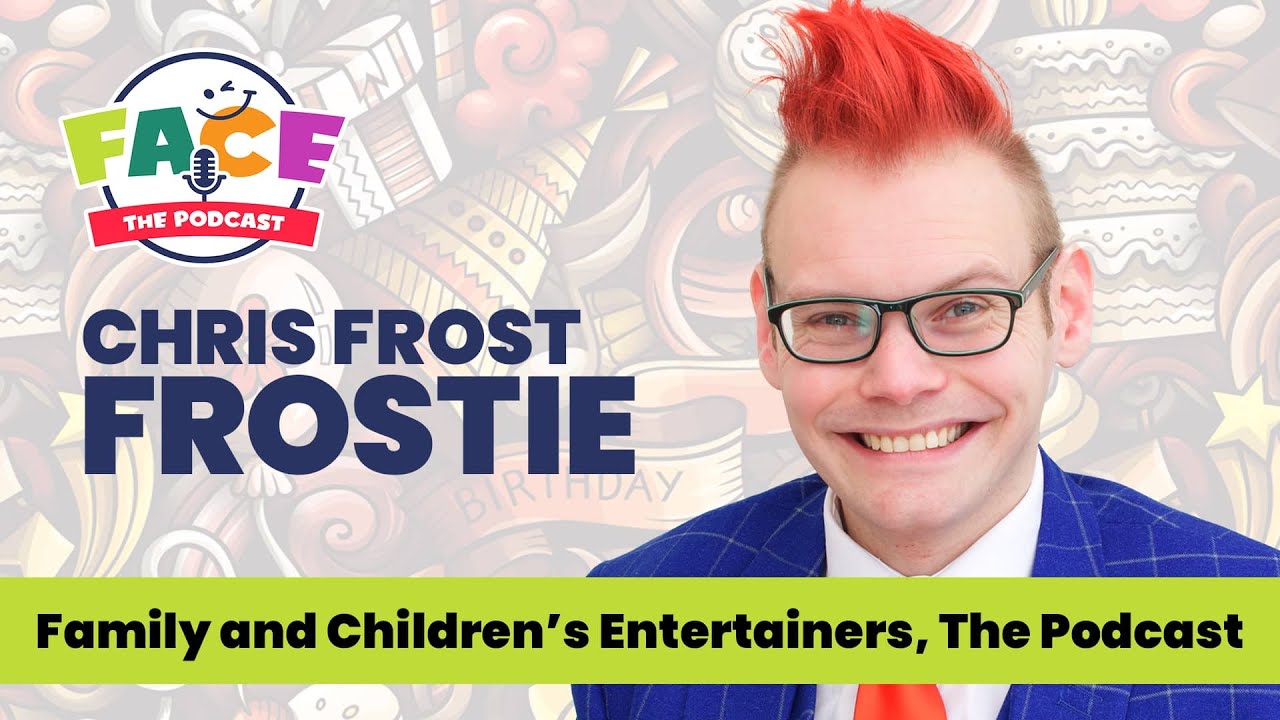
Hello, and welcome to FACE: The Podcast, the podcast for family and children's entertainers, where we talk to them about what they do and how they do it. And welcome back to this, our second episode. And I'm very pleased that this week's episode is Chris Frost. Now, he is better known to everyone as Frostie, and he is a very colourful character. He has so much enthusiasm and energy, boundless energy. We talked to him about how he got to where he is today and his journey so far. We also talk to him about his imposter syndrome. We also touch on the books that he wrote during lockdown as his way to use his creativity to escape the boredom of being stuck at home. Chris also tells us that he believes that magic is quite boring. So let's find out all about Chris Frost, better known as Frostie.
[00:01:14.820] - Gordon
So hello and welcome today, Chris Frost, Frostie the Magician. How are you doing?
[00:01:21.960] - Frostie
I'm very well, thank you. How are you?
[00:01:23.510] - Gordon
Very good, thank you. Thank you for joining us. So you have a very, very different style of entertainment from... I must admit, I've not seen you perform live. I've only ever seen videos and I've only ever spoken with you. So, how would you describe yourself and the magic that you do?
[00:01:45.290] - Frostie
So it's very much family entertainment. I do aim at families as a whole. So the way that I describe myself to bookers is less Justin Fletcher and more Ant and Dec. So Justin Fletcher is Mr. Tumble on CBeebies, and Ant and Dec, obviously, Ant and Dec, they've got Saturday Night Take Away and stuff like that. And it's more of a variety show. So there's magic, there's ventriloquism, there's singing, there's lots of different bits of the show. And it's aimed at children and their grown-ups, together.
[00:02:24.450] - Gordon
Okay, so let's look at your target audience then. So do you go out and do birthday parties in village halls, or do you prefer doing the big holiday parks or do you like big family fun days? What's your type of work that you do?
[00:02:46.130] - Frostie
I do do kids' birthday parties. I try not to, but they are a necessary evil to keep cash flow going. Yeah, I do do them. I am very strict with parents that book me for kids' birthday parties. I basically tell them, "Look, if you're booking me to do this, I'm running the party for you. And this is how it works best." And it is how it works best for me. That doesn't mean that it will work best for everybody that way. But for me, it means that I have complete relaxation and control over what happens when I get into the party, and it means that everything works. And I've been to kids' parties and there's been chaos. I've got two children of my own. But outside of that, yeah, holiday parks. I love doing holiday parks. I'm doing a holiday park tonight, which is lovely. It's only an hour away, so that's great. I love doing the holiday parks. I'm quite comfortable jumping on the stage and being in the theatre and having 500 people sat watching me, which doesn't happen nearly frequently enough for my liking. But getting those gigs isn't the easiest thing on the planet. And festivals. So that started off as the village fete, that sort of thing. And I really really enjoyed it. And I went, "well how can I get myself on stage in front of more people and interact with a huge crowd?" And so I designed a show which works in a festival environment. So if you think of something like the Green Belt Festival or something like that, where you've actually got... Or Geronimo was a big one, which was a horrible festival to work for as a supplier because we didn't get paid by them. They threw themselves into bankruptcy, but continue to put on the festival, even to this day. But that was a big family festival and it was like Glastonbury for kids. And it really was a phenomenal festival to be involved with. And working on it was an absolute pleasure, but it was an absolute nightmare, the admin side of it for that one. But then also there's now these things called bids. So pretty much every large town has got a bid, and they put on events and fun days. They're run by the councils, and they get given this money to just spend out and they have to spend it on stuff. So stuff like Christmas light switch-ons and stuff like that. But they will have three or four events throughout the year where they need to put on things and they're hiring great acts. I've worked with the Boom Town Rats because of it. I've worked with the Nova twins, really great acts because of these bid things that have started happening and building these huge festivals in little towns and stuff. They're really worth looking into as well. But yes, those are the things that I really enjoy doing. The festivals, the theatres, the holiday parks; those big audiences with a massive engagement rate as well. And definitely the right amount of back and forth for me. So the thing at a kid's party that I've always felt a bit awkward about is that it's somebody's birthday and I've got to get that kid involved in some way.
[00:06:29.240] - Gordon
You don't have a choice when it's a birthday party, do you? They have to come up and help.
[00:06:33.610] - Frostie
They have to come up and help, no matter how much they might not want to, or they might really want to, and be that kid that you really don't want to pick for something. There might be a kid that's perfect for stuff. You go, "That kid there would be great for this, but this is my birthday child routine, and I've got to use the birthday child." So, yeah, I do do birthday parties, but I am very, very controlling over them, which a lot of parents don't like.
[00:07:05.430] - Gordon
So what I got from that is basically that you are more of a family entertainer than a children's entertainer. You prefer having all the families there, you're having the adults there, which requires a completely different style of act and material, I would guess, which we'll touch on in a little bit later. Let's just go right the way back. Just very briefly, you worked in Spain for Rodney Piper. You came back and you've worked for Marvin's Magic, I understand?
[00:07:47.840] - Frostie
Yes.
[00:07:48.470] - Gordon
They're big chunks of time that you put into working for other people. Did you look at that as training for what you actually wanted to do, or did you not know what you wanted to do at that time?
[00:08:01.270] - Frostie
When I was 18 years old, I knew that I wanted to entertain people. I didn't know that this was a job. I went through school and I said, "I want to entertain people." They were like, "Oh, you want to be an actor?" I was like, "No, I want to entertain people." And the careers advisors told me that's not a job. That's not a thing. That's what I constantly got told. It's not something, it's not something, it's not something. And I went, "Well, it really must be." So I applied for holiday parks and stuff, and there was a few holiday parks when I was 17, 18 years old that I started applying for. And one of them was Pontins. And I also basically any "coat" style entertainment, I applied for because I knew it existed, but I didn't quite know how to get into it. And I ended up getting, out of that sort of first year, I got an acceptance for Pontins as a blue coat, and I got a "come and work for us," from Rodney. And for me, it was a no brainer to go to Spain rather than to go to Blackpool.
[00:09:18.460] - Gordon
So Rodney obviously saw something in you then. He thought, "Okay, this guy looks like he's hungry for the entertainment. He looks like he's going to do a good job." Because at this point, you hadn't done any entertainment? Or you had at school?
[00:09:32.330] - Frostie
I'd worked in musical theatre as a child. I'd done some shows and stuff. So I'm from Cheshire, and so I'd been in Manchester on stage. I'd sung for the Queen by the time I was 15, 16 years old. I'd been to Buckingham Palace because we had the Golden Jubilee and did the Party at the Palace thing. Sung with Cliff Richard, all this kind of stuff like that. I was very much sing, sing, sing, sing, sing. I had a really keen interest in magic. I loved magic and I'd hired my local theatre a couple of times and put on shows, just shows for cancer research and stuff like that. It was never to make money for myself. I didn't really believe that I should be doing that. It's dirty, isn't it? Making money for yourself. It felt that way when you're so young. I realised that it was 100 seat theatre and if I charged a fiver a ticket, that was 500 quid I could give to charity. Now I look at it and go, "That's 500 quid I could have kept for myself." But at the time, I was like, "That's a terrible thing to do. You shouldn't do that." I don't know why that was drummed into me either and who drummed that into me. But it really didn't seem like something that you should be doing, was what I thought. But I'd hired my local theatre. I did this job audition, interview/audition in Manchester and Wayne Goodman was there. I didn't know Wayne at the time. Because I had a keen interest in magic, but magic then existed in... Well, the internet existed, but wasn't a big thing. So there was nothing like Facebook or social media or podcasts or anything like this where you could find out who people were. My experience of magic was a Davenport's Magic catalogue, and I would sit in my room circling things from Davenport's Magic catalogue, "that sounds good" and then buying it, saying for Christmas, "I quite fancy this, this pair of scissors that can cut your finger in half," and then getting it and going, "Oh..." You know the thing I'm talking about yeah, with the mirror? And going, "Oh...wow, that's not..." But I wasn't interested in using magic for audiences either. I was sitting in my... I had a magic cupboard and I would say, right, I'm going to go and do some magic. And I'd go to my room for a couple of hours and play with magic and then come back downstairs and have my tea. So I had a Dove pan and flash paper. I was like, "oh, I'm 15 years old and I've got flash paper. This is something I like. I like this proof thing." And I sat in my room just ripping pieces of flash paper and going. "Oh. Oh. Oh." With this flash paper. And then I put a seven minute segment into my one man show, "Frostie the Showman," it was called, at the Harlequin Theatre in Northwich. And a local magician came, member of the magic circle. And I was like, "I have no idea how you do that," or anything like that back then. And he came and he went, it was a very good show. The magic was terrible, but the rest of the show was fantastic. I was like, "Oh, okay." I sang Robbie Williams swing songs because I liked them and I did some magic and I told some jokes and that was it, really. But Rodney, yeah, must have seen something in me. And I've been back to Salou now that I've got my own family and stuff. And I think definitely with Rodney, I was training. Rodney tore me apart and went, "Look, that was terrible." But he also tells you what to do, and how to improve. And at 18 years old, I needed that because I had a billion ideas, but I wasn't employed by him to do magic. I was working in the hotels and we used to do a show maybe once a week in the hotels and he would come and watch the show and he'd go, "Here's my notes on it." And boom, there's the notes. I go, "Oh, yeah, fantastic." And he really shaped me. And by the time I got to the end of that season, I knew that what I wanted to do was work, one, abroad, and two, I wanted to do magic because I was working with Wayne Goodman, Rodney, who is a fantastic magician and hypnotism, back then. His show was incredible. I don't know if he still does hypnotism or not. And Matt Edwards. And Matt Edwards would come into my hotel every other Thursday. And I did the sound for Matt's show. And I was like, I just used to watch Matt Edwards and go, "That's what I want to be when I grow up." I mean, Matt is probably only a couple of years older than me, but that's what I wanted to do. And his show was ventriloquism, magic and being Matt. And I was like, "I can't be Matt, but I can be me." And I'd like to go in that direction, definitely. So then I moved about in Europe and I worked for Thomas Cook. So Thomas Cook, I did lots of shows with Thomas Cook, but it wasn't until I was in Ibiza that I got free reign, is what I did, because the manager in Ibiza that I had, the entertainments manager, didn't last very long. But what he did at the beginning, because he did a three week training course where you learned all of the shows at the beginning. And we got out to Ibiza and he went, "Well, that was a fun three weeks." Went, "These shows are rubbish, let's get rid of them. Let's do it all ourselves." And I'd never been given that free rein before. "What do you want to do?" "I would like to do some magic." "Okay." So the 200 quid that we had to buy costumes for this routine, "there's 200 quid, go and buy yourself some magic." "Ooh, okay." The 500 quid that we have for this. We basically got given budgets because they hadn't sent out the costumes. They sent us the money to get the costumes whilst we were in the resort. And I got given money to do my own bits of act. I was like, "Oh, okay." Because he went, "There's no point to these shows." And he left and I became entertainments manager. But what I got left with was a cast of people that all had their own things they wanted to do. And it was great, including myself. So that was Ibiza. Then I moved to Portugal, and then I moved back to the UK and started working for Marvin's. Now, the first magic trick I bought when I was a child was in Weston Supermere in a shop called Masquerade. And a man called Steve was there, and there was the glass case of proper magic. It wasn't a magic shop, it was a fancy dress shop. but it had that magic cabinet. And I bought four sponge balls and a squeaker, two squeakers, one that didn't work. And I went to Marvin's Magic and got given sponge balls to sell. And I was like, "Oh, this is what I used to do when I was eight." So I found them very easy to sell. But I also realised that... So for a long time, I'd been working with people that were very, very similar to me, that had the same stamina as me, I guess. I realise that I've got boundless energy, which I've now found out is due to ADHD. I found that out very recently. But this boundless energy that I just keep on going and going and going and can do that without really needing to stop or take breaks or anything. And the other people I had been working with all the way through since I was 18, were all like that. And now I was in London and I was working with people that... Some of them were great, and some of them didn't want to be there. They wanted to do other things. "I'm an actor, really." "I'm an actor. This is just a stop gap for me." "I'm a singer." I was like, "Well, I want to do this. I want to be a magician." And I worked really closely with Bruce, who's in charge of training everybody in Marvin's magic. And Bruce used to bring people around and go, "watch Frostie, watch what Frostie does." And what I'd done was I'd basically torn apart the script. I'd done it as the script for a long time, but I worked for Marvin's for a good three years, I think, doing exactly the same thing over and over and over again. And it develops, but it's the same thing. And again, I got moved into management. I didn't enjoy being in management for Marvin's Magic. It wasn't something I wanted. I wanted to stand on a shop floor and perform to people. And so I said to Marvin, "Hey, can you demote me? Do I have to do this?" He was like, "No, not at all. No." He said, "If this isn't for you, then don't do it." Oh, good." So I went back to being on the shop floor. So I got made into management and then "Nah, don't like this," and back down again; I just didn't enjoy it. And I realised at that point that I, one, wanted to do what I enjoy, and two, wanted to do magic. And then the bookings started coming in. I was doing magic sort of on the side, and a bit of close-up here and a bit of family entertainment, a bit of kids' shows. It was the birthday parties, really, that got me snowballing. So the weekends I was going, "Well, I can't work this weekend in Hamley's, because I've got kids parties now." And then I realised that I was working seven days a week, five days at Hamley's and two days doing my kids' shows. And then went, "this isn't something..." Much as I've got two children, much as I've got boundless energy, maybe I need to drop one of these things. Well, let's drop the five days a week and just do the two. Now I find myself again working five, sometimes six days a week and not in January and February. That sounds like I'm blowing my own trumpet. But now, it's the Easter holidays and then it's going to be Whitsun. Now I get to this point where I'm like, "oh, no, I may be working too much again." Not that that's a bad thing, working too much. But it's difficult to talk about because people get upset about it. But it's, if you say you work a lot, but I do, I work a lot. I enjoy working. I also would prefer to be working than not. A lot of the time. I really enjoy it. I'm somebody that goes, "Oh, wait a second if that gig there..." Yesterday I gave out 750 Easter eggs. That's not an entertainment job. That's like promo staff job. But I got an email saying, "Hey, do you want to give out eggs?" And I went, "What a great job." I was like, "That's fun. I just get to give things to people for free and make them happy." And yes, I dressed up, went out, gave out eggs and gave out 750 eggs. Great. Wonderful.
[00:20:51.830] - Gordon
It's a great life we have, isn't it? Because you get these enquiries on the phone and you think, "Well, I've not done that before. That sounds like fun. I could do that." And then off you go. And there you are. You've got a brand new experience. But just going back on what you were saying there: you had lots of really good people right at the beginning when you, age 17, 18, around you, shaping your view of how magic should be, which you've kept with you. So my question was going to be, do you have any major influences? But it sounds like people like Rodney and Matt and Wayne are the people that gave you the image of what you wanted to be, right?
[00:21:38.050] - Frostie
Yeah. I mean, Matt, definitely. I was just really... So good people as well. Wayne, I was really, really close with Wayne. We had the day off together and he was top management. I used to just go around to his house, we'd sit and watch Penn and Teller, not "Penn and Teller: Fool Us," a Penn and Teller show. "In this one, we're going to be doing water magic in an aquarium." And just weird stuff that they used to do because they just did constant publicity stunts, didn't they? Penn and Teller. And he'd go, "Oh, look at this." And we'd watch a film or something like that. So yeah, Wayne I was really close to. Matt, I just admired. His talent was off the scale. You could just see the talent was off the scale. Also, there was a cast of people that were... So there was the House of Illusions then as well. So there was more magicians and stuff. I used to go there sometimes and watch the shows there. But also there was a musical cast and there was a guy called James who had spiky hair and he was just so charismatic. So charismatic. And I was quite shy then. I'm still quite shy now, really. You wouldn't expect me to say that I'm shy. But it's not.
[00:23:08.300] - Gordon
No, not at all. I know how energetic you are. And as you said, you've got boundless energy and you've always got this spark in your eye when you're talking about something that you enjoy doing. So, yeah, I find it very difficult to hear you say that you actually think you're a shy person. What makes you think you're a shy person?
[00:23:31.240] - Frostie
Maybe shy is the wrong word. Not very confident. I suffer massively with imposter syndrome.
[00:23:40.390] - Gordon
Even though you've been busy working and people are calling you all the time, and everywhere you go you get really good reviews, you still feel you're an imposter?
[00:23:49.990] - Frostie
Yeah, absolutely.
[00:23:52.060] - Gordon
Why?
[00:23:53.030] - Frostie
Because no matter how good I get, I compare myself to people that are better than me.
[00:24:03.470] - Gordon
But that's a way of pushing yourself, right? So that you can aim to be the best version of yourself you can be. So that's a good thing.
[00:24:12.730] - Frostie
Yeah.
[00:24:13.210] - Gordon
But I don't think that's a, I don't think that's an imposter syndrome. I think it's just wherever you are at the moment, you think you can do better. And I think if you stop getting to that point as an entertainer, it's probably best to quit, because if you don't want to get better, you're not interested in it anymore. So I wouldn't call that imposter.
[00:24:36.260] - Frostie
The best example of what I'm saying is Blackpool. So I went to Blackpool. This is my first ever Blackpool I went to this February, and I watched those Gala shows. It was the one that made me go, "That's what I want to do." The guy that did the cups and balls with the lemons. And I went back to my hotel room that night and I went, "Might as well just give up."
[00:25:03.820] - Gordon
Because you'd seen something really good, you thought, "I'm not as good as that, therefore, I should give up?"
[00:25:10.840] - Frostie
Yeah.
[00:25:11.830] - Gordon
Okay.
[00:25:12.190] - Frostie
What's the point? What's the point? What's the point of me doing what I do when I could be doing that? So everybody said to me, because Blackpool is great and fantastic. And everybody said to me afterwards, "Oh, did you enjoy your first ever Blackpool? Did you enjoy it?" And I went, "Enjoy it?" I was like, "No."
[00:25:33.920] - Gordon
I remember you saying to me, I saw you in the foyer and I said, "So how's your first Blackpool?" And you went, "My mind is not switching off. I've got way too many ideas in my head." So Blackpool was basically stimulating your creativity, but into a point where you've got three days of nonstop magic with hardly any sleep at all, and your brain was just getting a year's worth of magic creativity all in those three days, and you just couldn't shut down. Does that sound about right?
[00:26:12.610] - Frostie
Yeah, totally. And I said to my wife when I got, Amy said to me, she's like, "Would you do it again?" I was like, "Yeah." I said, "But I don't think it's enjoyable." I was like, "Everybody keeps going about how enjoyable it is." I was like, "For me..." I said "it's valuable, it's important, but enjoyable is probably one of the last things I'd explain it as." It's not a jolly. This is a really intense three days of learning and creativity. My head feels like I need to sleep for a week. We went on holiday the week afterwards. Went to Lanzarote.
[00:26:50.250] - Gordon
Just so you could... So let me ask you about this. So you are a very creative person. You're always coming up with new ideas, and you're coming up with new routines, new ways of doing things, new products you want to do. You want to go out and do mini golf and all these sort of things. So let me ask you a question here. With all of these ideas, how do you filter them down, work out which ones you actually want to work on, and actually then work on it, before you get distracted with something else?
[00:27:29.760] - Frostie
I guess budget is quite a big thing. I write everything down. I've got a notebook which is just filled with what I call my nonsense. My brain will just turf out ideas. Then I guess, one, am I passionate about it? Is it something I care about? Two, do I have the budget to actually do it? Can I do it? Is it physically possible? Three, can I write a script for it? I've had loads of ideas in the past and gone, "This is a great idea." And it is. And then I've tried to write it and gone, "No, it's not quite getting past, it's not getting any further." So I came up with an idea, the little mouse. Do you know the little mouse puppets? That you put in your hands, goes on your thumb, or maybe goes on that finger there, probably your middle finger it goes on, you hold it in your hand. I was like, wouldn't it be great to have a mouse on a pole? So you go, "This is my pet mouse." And you say, "This is the pet mouse," and you show the mouse. And then when you open your hands up, the mouse has gone. "Oh, my God. Where's the mouse gone?" This is all written down somewhere. "Where's the mouse gone?" And then this is a kid's party. You've got the mouse and you've stuck it to the back, a fake mouse, to the back of somebody's chair one of the parents. You go, "Oh, it's there." But as far as everyone's concerned, it's a real mouse. So that makes somebody go, "Ahh!" Like that. You grab that mouse, you hold it in your hands, make it disappear. "Where's it gone? Where is it? Oh, wait. I think it's in my trousers." And then you start shaking your leg. "Oh, my goodness, it's gone to my leg." Like that. Comes up to the body because then you can do this great visual miming, physical comedy with it. It goes up your legs into your suit jacket, and then you put your hand in there to grab it and bang, you have that mouse trap gag that comes out on your finger "aaahh" like that. And like maybe a little giggle from the speaker, which is the mouse giggling because you've been got by the mouse trap. Now, that sounds like a great idea and a great routine. In practise, this went quite far in development, to the point of performing it. What actually happened with this was, one, here's a mouse, all the kids like the mouse. You do this, it disappears, the mouse, from your hands, and the kids go, "Oh, it's gone. It's up your sleeve." Well, actually, it's gone as close... Reels don't go up your sleeve, but it's gone as close to up your sleeve as it can do. And the kids are convinced it's gone up your sleeve. "It's gone up your sleeve. It's gone up your sleeve." "No, it's over there." "No, it's not. It's up your sleeve." I was like, "No, it's over there." "No, it's up your sleeve." I was like, "No, this isn't that..."
[00:30:31.700] - Gordon
I've got another three stages. Just stop talking. Listen to me. This is where it's going to be now.
[00:30:38.920] - Frostie
Then the adult's already knocked it off the chair. So we are, "Well, where has it gone? Where's my magnetic mouse gone? That's over there that needs to be attached to this other reel." The whole thing just didn't work. And really, it's because, there's a reason why nobody does all that before the mouse trap gag, because all you need is the mouse trap gag, which I think, it was a John Breeds thing originally.
[00:31:05.420] - Gordon
Yeah, I believe it was.
[00:31:07.510] - Frostie
It's the mouse trap with the snappy thing on the back with the caps. Bang. Great gag, very funny. Boom. You put your hand in your pocket, you pull it out. But I was like, "There needs to be more to that. Why have you got a mouse trap in your pocket? But what if the mouse is trapping you?" None of that needs to happen. But then other stuff, I um. This is... So the Mummy trick that I brought out, I don't like Farmyard Frolics because it doesn't have an ending. So I believe very much in things having a clear beginning, middle, end. Farmyard Frolics is a good idea for a trick, but it's not finished. I think Farmyard Frolics is the original, isn't it?
[00:31:55.660] - Gordon
Yeah, I believe so. It's been one of these tried and tested effects. But you're right, it doesn't have an actual wow finish, does it?
[00:32:07.140] - Frostie
It doesn't have a finish. The cat pops out, pops out, pops out. You put the cat in the thing, you close it, and that's the end. Now you put it away. And that's the same with so many kids' things. We've done that. Now let's put it away. And I go, "This is really great. The kids all love it. Why at the end do we go, And now let's put it away?" The other thing that I really liked was "Oh Mummy," which is an old Supreme trick, which is a very funny idea, but it's far too adult for a kid show and far too silly for an adult show. So there's no way you can use this in any professional situation. It's just a prop to have, which I think is quite a few of the Supreme things. But I went, "Wait a second, actually, the idea of a Mummy losing its bandages is great. Why would the Mummy lose its bandages? Well, wait a second. This is a thing that thing can pop out from. Wait a second, that's Farmyard Frolics. I'd seen Sammy's, Razamatazz one, the Halloween one. I'd gone, "I like that, but it's not got the ending." I spoke to Sammy about it before I talked mine out. And Sammy was like, "Yeah, absolutely. Go for it." And I think that's one of the things that's really nice in Magic. It is supportive. People generally do support ideas and stuff, even if there's a similar. He was like, "It was never my effect in the first place, it's Farmyard Frolics." I went, "Right, I'm going to make that." And you start with nothing in the tomb, close the tomb. Oh I've got my monster file. Here's all my monsters. Each monster's got a gag. There's the mummy. The mummy disappears. Is it in the tomb? Now it pops out. Then it goes inside. And rather than going, "And now we put it away." Going, "Oh, no. Now one of its bandages has come out." Boom, boom boom boom boom. Open it up and the Mummy's naked. "Oh, no!" That's a reason to put it away. It's like, I hate illusions. What's the point in a box and showing everybody an empty box? I can't think of anything worse than going and watching something and a magician opening a box to show me it's empty. What's the point? Showing me an empty box is the most boring thing you can show me. Now, how can you prove a box is empty by having something inside it? Yeah, taking something out of it now proves that it's empty because you've seen inside and it's definitely empty because there's nothing in it, because you've taken the thing that was in it, out of it. So I did that with the toy box to make a Teddy Bear appear. That took a long time and I have now found a lot of time, a lot of expense. I ended up spending hours making an animated thing. So the front of it had an iPad in it. So when I touched it with a D light, the light lit up and the Teddy Bear appeared in a shadow, like a shadow box illusion. And I never use it now because I found a better way of doing it which cost about £100. And I went, "I've literally spent about a grand and a half on that box," getting it from first incarnation of it to the last incarnation of it where I wanted it. And now I never use it.
[00:35:43.930] - Gordon
But that is sort of the price you pay for developing unique props that only you use and only you do, isn't it? So yes, it's grand and a half to develop it, but you're going to likely get more than a grand and a half's worth of bookings because of that, because you're the only one that does that.
[00:36:08.030] - Frostie
Making a Teddy Bear appear is a phenomenal thing to do, especially if you can give the bear away.
[00:36:15.740] - Gordon
Yeah.
[00:36:15.940] - Frostie
But it was always me that made the Teddy Bear appear, whereas now the child makes the Teddy Bear appear. So that's much better.
[00:36:28.610] - Gordon
So yeah, that's really interesting. Having the child produce the Teddy Bear is a very magical thing. Anything where you can put magic into the spectator's hands is a much more powerful piece of magic, I feel.
[00:36:40.430] - Frostie
I guess the reason why most... So I said I don't like an empty box. So that all came really from not liking illusions. I wrote a poem about strawberry laces so I could do 'Professor's Nightmare,' because I can't think of anything more boring than watching a magician faffing about with some ropes. So torn and restored newspaper makes absolutely no sense to me. Getting a newspaper and ripping it up so that you can put it back together again doesn't make any sense.
[00:37:20.210] - Gordon
Do you know what doesn't make sense for me? It's when they restore it, and then they screw it up and throw it away. It's like grrr.
[00:37:30.410] - Frostie
It's a very bizarre concept. So at the moment I'm working on a torn and restored project, which makes, narratively makes sense. And for me, I guess everything that I create, I create with a purpose of one, being able to use it myself, and two, it's improving an idea which to me just... I find magic a bit boring. I find magic by magicians quite often to be the opposite of magical. There's a very big difference between magic: I have done something which is impossible, and Magic: that's incredible! I find magic to be quite boring.
[00:38:28.780] - Gordon
I always got from you that your show was lots of bits of business with some magic in it. But you're saying that the magic can be very boring, yet you're making the magic better. So the magic you do have in your show is very strong. Is that right?
[00:38:50.660] - Frostie
I don't know if it's very strong. I guess the question that we should ask ourselves as magicians is, did they believe they just saw Magic, or do they believe they just saw a magic trick? If they believe that they've just seen Magic, which involves having a story, then they shouldn't be impressed by what you do because you should just be able to do it anyway. Whereas if you do a magic trick, they're impressed by what you do because they know that you've done something clever.
[00:39:28.660] - Gordon
So for me, something that's Magic is how the audience feel about it. So if they feel like they've experienced something magical, then what they've seen is magical. Whereas if they don't feel that magic, it's just a magic trick that, "Okay, I don't know how it works, but I could probably figure it out."
[00:39:50.220] - Frostie
Yeah. So going to Disneyland, if you go to Disneyland, Magic of Disney Land, that's what they deal in, Magic, you will not see any magic tricks. I had a theme park contact me to be the magic consultant for the theme park in this country, a new theme park, and they said, We want to put in magic tricks, so each character can do a trick. And I said, "Whoa, whoa." I was like, "The best thing you can do to make it magical is not put any magic in." I was like, "If you put a little speaker up there that plays this bit of music, if you put a smell pump over there, which pushes this smell into the room, that's what magic is. If you change the lighting ever so slightly, you can make people feel different things. You put an air conditioning unit in that room there, the room's colder, now it's haunted." There is a place for magic tricks. I would say the magic is more than that though. It's definitely an emotion. It's an emotion felt by an audience member. It's not what I do. It is how other people react to me. So all those bits of business, so like I can't bear any of this time filling, here's a wand, there's another wand, there's a wand, there's a wand, there's a wand, there's a wand, wand, wand, wand, wand, wand, wand, wand thing. I'd much rather get to it. If there's a magic wand, if this pen is a magic wand, then it should be magical. This is something incredible now. This is something which should be looked after, cared about. It's special. It should be looked after by me. It should be looked after by... Even if it's a rising wand, a Silver Sceptre, it can do silly things. It can make me look stupid. But I've got to give this the utmost respect. This is something hugely important. This is something Bruce Smith taught me. This isn't a deck of cards. Most magicians go, "This is an ordinary deck of cards." I'd much prefer to go, "This is a very special deck of cards." They don't care. They don't care if it's a special deck of cards or an ordinary deck of cards. But what you've just done is you've changed their perception of what the cards are. These cards are magical. I'm not magical. The things that I have are magical. I'm an idiot. And the things that are around me are magical things that I have the utmost respect for. I do the umbrella, the colour change umbrella, "Mutilated Parasol." It's in my showreel and it's a continuous gag throughout the show is that I can't put the umbrella down. All I'm doing is pressing the button. It's an automatic umbrella. Boom, it shoots back out again. So I close it down, put it back down. I hold it out to the side of me. It's the look, don't see thing. It goes, boing, like that. Now, I'm pressing a button to make that work. That's not a magic trick. There's nothing magical about it. But the audience, by the time it's the third or fifth time of going, boom, they believe that the umbrella is completely in control of what it's doing. And that's literally just pressing a button on an umbrella.
[00:43:08.780] - Gordon
We'll be right back with Frostie in just a moment. But first, a word from our sponsors. This episode is sponsored by me. I run a company called Drayson Design, and this company produces print artwork for business cards, letterheads, but also hosting and website design. I'd like to talk to you very briefly about my website and hosting design today. I host about 250 websites currently, and the majority of those are entertainers. I specialize in entertainers' websites. I haven't built all of them, but most of them I have. And I can build them from scratch, having discussed with you what it is you're looking for in a website. And because I am also an entertainer, I have a lot of inside knowledge as to what works and what doesn't work based on my own experience with my own websites, and those of my customers. I can take the initial idea, colours, and design that you have for your website and turn it into a fully featured, finished product. Once it's done, I can also maintain the website for you, making sure that it's up to date at all times with all the software and security fixes that need adding. The website can be built to allow you to add content whenever you want, whether that be for blog posts, updating images, or changing text on the website. The cost of all this is very reasonable, and you can find out more by going to the website, www.draysondesign.com. Right, let's get back to Chris Frost.
[00:44:56.570] - Gordon
So let's just go back to your character then. You've just said there that your character is that you don't understand what's going on and that you have these things that have magic in them. So as far as an audience member, let's go for a family at a family show, are watching your show. How would you describe your character to them if they hadn't already seen your show?
[00:45:26.250] - Frostie
Basil Fawlty.
[00:45:29.310] - Gordon
Okay. Wants to be in charge, but doesn't actually have any idea of what's going on around him.
[00:45:34.880] - Frostie
Yeah, absolutely. I'm pretty much having a breakdown on stage because of the things that are happening around me. My puppet is Manuel. So I'm Basil Fawlty, the puppet's Manuel. The puppet is naughty, and I'm furious with it. Although probably less abrasive than Basil Fawlty, Basil Fawlty's quite violent and horrible, not a very nice man. I'm a nice man. I'm basically me. I'm a dad. I'm a dad trying to keep control of the things that are happening around me. And I talk about being a dad as well in my shows. So I talk, I guess it's verging on doing stand up comedy. I talk about stuff in my life that's happened with my kids and make it funny. But other parents, every kid in the room can relate to it, and every parent in the room can relate to it. Robert Lindsay in My Family. If you look at sitcoms, Basil Fawlty, Robert Lindsay in My Family. As a child, I watched My Family and I loved it because I could relate to the kids in My Family. And I went, "Oh, isn't this funny?" As an adult, I now watch My Family with Robert Lindsay and go, "I'm the dad. I can relate to the dad." And watching that recently on BBC iPlayer, I've gone, "Wow, what a cleverly written sitcom," because as a kid, I totally got it. As an adult, I get it on a totally different level. But it's not a Shrek humour, which everyone goes, "Oh, it's the Shrek comedy humour." No, you've written two, one sitcom with two absolute markets in it.
[00:47:32.240] - Gordon
They do that so you have to go back and re-watch them when you get older. That's how they do it.
[00:47:38.950] - Frostie
Yeah. Basil Fawlty, I always just found to be very funny, but that's John Cleese doing what John Cleese does best, which is being a slightly angry man.
[00:47:51.560] - Gordon
Out of control.
[00:47:53.940] - Frostie
Yeah, he was out of control. And with fantastic physical comedy. I love physical comedy. I've always had the Marvin's Magic hand in my show, the "Freaky Buddy" illusion. And now everybody's obsessed with the Wednesday dance, so stick the Wednesday dance in. Now I'm picking up the Thing, but it's just a statue of it until it starts moving and then starts whacking me in the face and all this kind of stuff like that. But the physical... There's a lot of work that goes into the miming of that routine, which people I don't think would ever notice unless I didn't do it. Slightly raised on my tiptoes when it goes up my nose, when it slaps me in the face, my right leg flies out to the side. There's loads of little touches that I put into it because it was very important, it was funny. Because I hit myself.
[00:49:00.480] - Gordon
What other special skills would you say you have that helps with your performing? Because you've just mentioned mime there. You used to do musical theatre, as did I. I did an awful lot. I did all the classics with my local am dram company with Brigadoon and Oklahoma. All of the classic musicals, which is great because it gets you stage time. You get to learn how to perform on a stage, albeit with a load of other people, but it's really good training. So what other skills? You obviously sing because you have songs in your show. You were talking about singing for the Queen. So what else do you see yourself having, whether it's something you've actually learnt or it's something you've gone out and learnt or it's something you felt you needed? What other skills do you feel you have that help with your performance?
[00:49:56.390] - Frostie
I guess writing's been a massive deal for me. So I say I wrote a poem about strawberry laces because I wanted to do that with magic. There's something very powerful about standing on stage in front of loads of people and having, and confidently delivering a poem. It's quite a scary thing to do.
[00:50:22.570] - Gordon
Especially one of your own as well. If people know it, there's a little bit more of a cushion there. But if it's one of your own, yeah.
[00:50:30.020] - Frostie
Yeah. I write. I write for me. I write, I've written a whole magic show. I talked about this in my lecture. I can't talk too much about it at the moment because somebody wants it, but I've written a whole magic show which isn't for me. I walk on stage, and the moment I walk on stage, I see an audience and my mouth goes, "Hey." I've written a ghost story based on a haunted house and the whole thing is based on bizarre magic. But it's the story, really. The story arc of it is something which would work on Inside Number Nine or something like that. I love horror and ghost stories. Not horror so much. Ghost stories, properly embedded... Ghost stories don't need to be scary. They just need to be eerie. Basically, I've written a ghost story, which is a wonderful thing that I've always wanted to write. And then gone, "Well, I can't perform that because this." I've got a stupid face. Yeah, Derren Brown could perform it. Andy Nyman could perform it. But I... Here's my stupid ghost story. So writing for kids, I love writing. So doing a torn and restored treasure map. Suddenly I've got, well, wait a second, it's a torn and restored newspaper, but it's now a treasure map. Now where's the story? Why is it being torn up? Who's tearing it up? Who finds it? Who finds a torn up treasure map? Who restores the torn up treasure map? And then at the end, you give the treasure map a shake and all the coins fall out of the treasure map and you've shown all the different sides and everything like that. That's what I'm currently working on for my next bit of show. I enjoy writing. I don't know if it's a particular skill that I've got. Nobody buys my books - available on Amazon.
[00:52:50.970] - Gordon
That's something I was going to say. So you've written children's books. So you have books that you wrote because you wanted to? You wrote them for your children? You wrote them to sell? What was the goal in the beginning for those?
[00:53:04.910] - Frostie
So the first book that I wrote, the first children's story I wrote, the goal was to get out of the house. Because it was in 2020 I wrote "Milo Swan." And I was waking up and going, "Another day of staying in? How do you get out of the house when you're not allowed out of the house? Let's create an outdoors. Let's make myself go outdoors." Ironically, one of the main characters is agoraphobic in it. I think it's my breakdown in the book. It's my breakdown in a children's story that I had in 2020, but I loved writing it. And then I went, "Right, I'll write the next one. And so I started writing Milo Swan, the second book. I went, "Well wait a second, this story's finished." And I went, "Oh, there isn't a next one." And then I went back home, I went back to my parents, and I was going through some old notebooks, because I've always written since I was a kid. You write stories as a kid and you write the first couple of pages and then you never think about it again. I picked up a notebook that I had written ideas for game shows because this was my childhood. I would write down every idea that I had. What about having game shows and this and that and the other thing. One of the things that I'd written down was called "Johnny Roger and the Pirates of the Point," because we used to go to Portsmouth on holiday and we used to go to the Point. And I'd written this story about Johnny Roger, which I thought was a very clever name because it sounds like Jolly Roger. And I brought it back. I brought it back to Essex and I went, "Okay, I remember writing these bits and the story plan here. I wonder what would happen if I wrote this story?" And so I started writing about these twins, Johnny and Polly. Polly Roger and Johnny Roger. And as the story went on, Johnny became a bit less... Johnny was a bit boring. And so all of his character got put into Polly's character, and her dialogue became more. And suddenly, two characters became one character. "The Pirates of the Point" became "The Pirate of Pelican Point." So three Pirates became one Pirate. And these characters became really rounded and well developed and I went, "Oh, okay, I enjoy this." I wrote Polly's first story and knew that there wasn't enough of it. It finished, but that's just the end of that bit. There's at least two more stories. I'm about halfway through Polly's second story at the moment, writing it. I write them for my kids. I read them to them at bedtime and stuff like that. We like reading bedtime stories and I like doing all the voices. I think that if you write your own children's story, nobody can read it better than you. And also some of the kids' stories that we've got are terrible. David Walliams can't write for toffee. It's all celebrity authors now, and they're not very good. They get publishing contracts because they're celebrities, not because they're authors. And so I go... And some of them are really good. Tom Fletcher's really good. Greg James is really good. But some of them are abysmal. Even the grammar, who's checking, who's proofreading these books?
[00:56:59.610] - Gordon
So basically, you're looking for a new contract from a publishing house to get a whole series of books out about Polly Roger and all of her adventures.
[00:57:11.630] - Frostie
I would love that. But I grew up reading Michael Morpurgo, who is an author, who's famous for being an author, Dick King Smith, who was famous for being an author, JK Rowling, and Terry Pratchett, and stuff like that, and going, "Well, these are authors." Douglas Adams. They're people that are authors. That's what they do. They write books. Now it's celebrities that write books. Not celebrities because they write books. I started writing and just really loved writing. I write them for me. I'm illustrating this one as well. As I go along, I'm going, "Oh, I'll draw a picture there."
[00:57:52.660] - Gordon
There's a new skill for you then? There you go. You can add drawing in.
[00:57:58.130] - Frostie
I enjoy doing it.
[00:57:59.430] - Gordon
You can have a bit in your next show where you do one of these drawings and then it changes, and then you can keep rubbing bits out and adding bits without redoing the whole thing and tell a whole story that way. I can't remember the, there's a name for it. I can't think what it is but.
[00:58:15.740] - Frostie
I've always wanted to have the confidence to just stick an easel on stage and do an upside down painting.
[00:58:22.150] - Gordon
Ah yeah, it'd be great.
[00:58:23.630] - Frostie
Joe Pasquale does it, I think. I've always wanted to do the Mona Lisa.
[00:58:29.150] - Gordon
I think it's been done, I'll be honest.
[00:58:31.340] - Frostie
It probably has. Probably by Joe Pasquale, who nicked it off someone. But I'd love to have the confidence to just put some music on and paint on stage, and give away the canvas. I used to do it with the Rubik's cube.
[00:58:55.040] - Gordon
The Blue Man Group do it. If you've seen the Blue Man Group show, they have a canvas with a painting that they sell at the end of it.
[00:59:03.980] - Frostie
I don't think it would fly at a Haven holiday park.
[00:59:06.540] - Gordon
No, I don't think it would.
[00:59:09.260] - Frostie
My greatest skill is knowing that I don't want to have a proper job and I don't even want to do this if I'm not enjoying it. And so it's make things enjoyable for me because if you enjoy what you're doing, then other people will enjoy what you're doing. And that's what entertainment should be.
[00:59:29.680] - Gordon
I think that's right. You can tell just by looking at someone, whether they look uncomfortable, whether they look confident, whether they're enjoying it. And I think that does rub off on an audience quite a lot. They can sum up a performer very, very quickly. So yeah, I think you're right. I think you're right. Right, let's have some quickfire questions with answers as long as you need them to be. But I've got a few of these.
[00:59:59.820] - Frostie
Okay.
[01:00:00.940] - Gordon
Any funny stories that have happened to you at a gig that you are happy to share with us?
[01:00:08.460] - Frostie
Oh, plenty. I'll tell you about the worst gig I've ever had.
[01:00:11.390] - Gordon
That was my next question.
[01:00:13.620] - Frostie
Oh, really?
[01:00:14.260] - Gordon
Yeah. So let's do that one then. Worst gig ever.
[01:00:18.830] - Frostie
This is not particularly a funny story. And looking back, it is. It was after the pandemic, and it was my first gig after the pandemic, some parents had gone to the end of the garden, big, long garden, to have drinks whilst I entertained the children. I was already uncomfortable when they said that. One of the children decided that they didn't like me before I'd done anything, and started throwing mud at me from the garden. I ended up continuing for as long as I could until I just ended up with a splat of mud in my face and going, "I can't continue any longer." At which point, covered in mud, I stopped my music, I stopped and I started packing away. I called over the parents. I had called over the parents several times, but they hadn't bothered coming. They did when I turned everything off. I said, "I'm really sorry, I can't continue." Covered in mud, "this child has thrown all this mud at me." At which point I got told, "They would never do that." But I was literally covered in mud.
[01:01:30.910] - Gordon
So they thought you did it yourself?
[01:01:33.600] - Frostie
I have no idea what was going through their minds. It's the only gig that I've ever gone, "I've got to stop. I'm not doing this." So that's it.
[01:01:46.780] - Gordon
I think that qualifies.
[01:01:47.470] - Frostie
I can think of a worse gig, which was last Christmas. So I suppose this is where the imposter syndrome thing happens as well. Everyone's having amazing Christmas gigs. I've got a brilliant Christmas show. People love it. They adore it. I go out and do one show and it's horrible. Somebody booked me for four hours, alarm bells should have been ringing already, for a children's football party. All the footballers from all the different ages across this county's football club.
[01:02:18.780] - Gordon
Is there more mud involved in this? It sounds like there should be.
[01:02:21.930] - Frostie
No, this was indoors, and the parents were all there and the children were there. I started doing my show and realised that nobody wanted to watch it. The parents were all incredibly drunk. The children were left to run riot. So I started having a disco dance off competition whilst I tried to work out what to do for the next three and a half hours. 45 minutes in, I introduced Father Christmas onto stage. He came out and sat down. We hire out our own Father Christmases. And I got given a list of... This is the yellow under seven club first, then red under seven club. So I'm announcing yellow under seven club, but nobody's listening to me. The kids are coming up. I'm going, "Are you under seven?" They go, "I'm nine." "Okay, so you're not under seven?" "No." "Okay, you're going to be called up a little bit later." "But I want to see Father Christmas." "Yes, you will do but..." This queue of maybe 500 kids to see Father Christmas, this went on for ages. Thank goodness. Then a little bit of a disco. I was like, "Oh, my goodness, what am I going to do now for the next two hours?" I basically spent the whole four hours wondering what I was going to do for the next amount of time because nothing worked at all. And I ended up going back to my holiday rep days and doing an adult game show, getting five of the dads up onto the stage and getting them to do, because it's a football club, to do their best goal celebration, and play go fetch with them, which resulted in doing what I thought I'd left behind a long time ago. Go fetch a sock, go fetch a pint of beer, put the sock over the pint, and whoever drinks it first wins. And it went down an absolute storm. But I was like, "I thought I'd left all this behind so long ago." But that was that gig. And do you know what? It worked. But it wasn't what I wanted to be doing.
[01:04:22.050] - Gordon
But you had the experience to know what you thought would work. And as soon as you figured that out, everyone had a really good time, right?
[01:04:33.120] - Frostie
Yeah.
[01:04:34.210] - Gordon
It's the experience.
[01:04:35.130] - Frostie
I just never expected to be a children's entertainer doing Club 18-30 rep games.
[01:04:39.650] - Gordon
No, I get that. But you end up doing what the audience want effectively. You're performing for the audience, which shows you're not an imposter. You used your experience and you brought in, once you'd figured it out, what was going to work well.
[01:05:02.670] - Frostie
Yeah.
[01:05:02.950] - Gordon
So let's go to the other side of the scale. Best gig ever.
[01:05:06.700] - Frostie
Best gig ever? So probably the first time that I realised that I could stand on a stage in front of thousands of people and do it, which was Milton Keynes 2019 Christmas light switch on with East 17. And East 17 were not ready to come on stage. And basically I was hosting the stage. So I had all my stuff at the side of the stage. I had a thing in my ear with somebody going, "In the next five minutes, we got so and so coming on," and me going, "In the next five minutes, so and so and so." And I hosted the whole stage. I had nobody anywhere near me telling me what to do. I just stood on stage and I adored every moment of it. And it was when I had two minutes until East 17 come on, I was like, "Okay, two so," start wrapping things up, start building the crowd up. And then about 30 seconds late... No, probably about a minute later, so with one minute to go, I got, "East 17 aren't ready yet. About 15 minutes until they come on stage." And I just went, "I've got 15 minutes more until East 17 come on." And the crowd are so ready. They'll do anything. I've just got them here. They're in the palm of my hand. I didn't panic. I just went, "Oh, I've got an extra 15 minutes. In that amount of time, I can sing a Christmas song and get everybody singing along. I can do a vent routine, or I can do a magic trick, and everything's to the side of me here." I didn't need everything to be at the side of me because all I was meant to be going on for was a couple of minutes each time to announce the next act.
[01:06:57.020] - Gordon
But your experience said, "Have it in the wings just in case."
[01:07:00.690] - Frostie
Always take far too much stuff with you just in case.
[01:07:06.460] - Gordon
Always.
[01:07:07.470] - Frostie
I'd love to be somebody that can just stand on stage with a microphone. Need nothing. That's the dream.
[01:07:13.760] - Gordon
But that wouldn't be you then, would it?
[01:07:16.240] - Frostie
No, not at all. No. So yeah, that's probably the best gig that I ever had. And then most recently, Oliver Taber asked me to be in West End Magic in Leicester Square Theatre. And I went, "Why me?" And I did a gig with Mark James and Guy Hollingworth. There's a really funny picture where there's Oliver Taber in his black suit. There's Wayne Tryson's black suit. There's Mark James in a Navy blue suit. I'm stood next to Guy Hollingworth. I don't know how many children's entertainers will know Guy Hollingworth. Guy Hollingworth is incredible, but very sensible, very dapper. He told me he was a barrister and I asked him for a latte. But yeah, and then there's Guy Hollingworth in his perfect tails jacket, his white waistcoat, his bow tie. And then there's me in a bright pink suit. It's a really funny photograph, I think. It's not meant to be funny. It's just I just look so odd in it.
[01:08:32.770] - Gordon
Sounds like a perfectly balanced show.
[01:08:36.030] - Frostie
It was. It was a really well balanced show and it was phenomenal to be part of it. And you know when the audience are right. There you've got a paying audience that are going to see a West End show and the whole point of the West End show is that they're going to watch magic. That's the right audience. That's the perfect audience. And it's a family audience. It's kids and adults. That was the dream that was. But then there's also been Havens as well, which have just been great because the room's the right set up and the speaker's in the right place and the audience have been really great. It's all about the audience, really, isn't it?
[01:09:17.460] - Gordon
Yeah, 100%. It's how they make you feel, isn't it?
[01:09:20.820] - Frostie
Yeah.
[01:09:21.130] - Gordon
Going back to the feeling.
[01:09:22.230] - Frostie
But the question shouldn't be what's your best show. It's "who's your best audience been?"
[01:09:26.700] - Gordon
And once you get your right audience, you just want to make sure you try and replicate that again and again.
[01:09:32.010] - Frostie
Yeah, which is really hard.
[01:09:33.550] - Gordon
It is very hard, I agree. So two more questions for you. We could carry on for hours because we haven't even touched on the other things you do for entertaining, like your mini golf and all that lot. So we might have to come back to you and talk to you again sometime. What advice would you give yourself if you could go back to when you were 17 years of age, just starting out knowing what you know now?
[01:10:04.900] - Frostie
Don't be shy to ask for money. I said at the very beginning of this, when I first started out, I just thought money was dirty and why am I getting paid to do this? Why am I getting paid to enjoy myself? Now somebody says, "Do you want to give out some Easter eggs? How much would that be?" And I go, "500 quid?" And they go, "Okay." At the end of the day, you've got to eat. You've got to put clothes on your back. If you've got kids, you've got to put clothes on their backs, feed them, pay your mortgage, pay your rent, whatever you've got in your life. You've got all these outgoings and nobody else is scared to ask for money. So the advice that I would give to anybody is don't be afraid of asking for money and asking for as much as you want. People can say no, or they can go, "That's a bit much." And you go, "Okay, well, what sort of price for you looking for?" It's much easier to go down than it is to go up. You can't go up. If you say £200, they go, "Okay." But if you say £500 and they go, "Oh, we were thinking £300," you're still £100 quid better off than your £200 quid so. Don't be afraid to ask for money. That would be the advice that I'd give. As far as job wise, I wouldn't change anything. I always say that I wish I'd started doing this earlier, but I always think that's because I'm now where I am. And I go, "Oh, I wish I'd been able to do this earlier," but I couldn't have done what I do now without the experience that I had before. So I wish I'd had the experience, but you can't get that before you've got it, if that makes sense.
[01:11:46.900] - Gordon
Yeah. I think things happen at the right time, don't they? And unless you go through the process, you're not going to end up being the person you are now. So if you'd missed out any of those steps, you would be a very different person.
[01:12:02.520] - Frostie
Yeah.
[01:12:03.100] - Gordon
So yeah, I think experience is a really important thing. And it's something that we've had come up on these podcasts several times. But go out, get experience. And then when the time is right, you'll become who you hopefully want to be.
[01:12:16.260] - Frostie
Yeah, absolutely. And eventually I'll be that person that I want to be.
[01:12:22.510] - Gordon
Do you know what? If I was as far along as you are now, when I was your age, I dread to think where I'd be now. I had to do everything myself, and I didn't have as much help as you had because I didn't go off and do the Spain thing and surround myself with really talented people. I was sort of on my own. I did do a holiday park. I was a blue coat for Haven Warner, in fact. And that was a really good experience. I did that for a year. But then I came back and it's like, "Right, I want to build myself up as a magician and entertainer." And I had to work it all out myself, really. So I did have help. I did have various people who I got advice from and help. But being within an area, living with them, as it were, in Spain as you were at the time, and having access to all that knowledge and experience really does help to push you forward a lot quicker, I feel.
[01:13:25.240] - Frostie
You're so embedded into it.
[01:13:26.980] - Gordon
Yeah. You start learning the right ways to do things rather than learning the wrong ways and then figuring out what the right ways are, if that makes sense.
[01:13:36.090] - Frostie
Yeah, absolutely.
[01:13:36.980] - Gordon
Yeah. So anyway, congratulations. I look forward to chatting with you again. I wish you all the best for your gig tonight and all the gigs you have coming up. Thank you so much for spending time with us and our audience. This has been a fantastic interview with Chris Frost, better known as Frostie. Thank you for your time.
[01:14:01.280] - Frostie
Thank you very much. It's been a pleasure. Thank you.
[01:14:04.480] - Gordon
So there we have it. Chris Frost, the man with boundless energy and creativity. I think you can agree, having listened or watched this podcast, that he is one of these characters that will just keep going and creating forever, and innovating and pushing our art forward, which is exactly what we want to make ourselves relevant in the future. I'd like to thank Chris for spending time talking to me and pretty much answering any question I had. He was very open and honest. The one thing I don't quite understand from talking to him is his imposter syndrome. Having listened to him, I don't understand where this comes from. He is doing incredibly well at what he does, and I think he deserves all the success that he has had to date, and I'm sure there will be a lot more success in the future. Please keep an eye out for some of the products that he has put out. His Mummy trick is fantastic and his recent product is his Popcorn trick, which is just really, really innovative and interesting. If you do the the lolly trick, this one will work just as well and be an alternative for different events where you're going and seeing the same people. Thank you for you very much for joining me with FACE: The Podcast. As always, we can be found on YouTube. You can subscribe, and share, and like the videos on YouTube. There is also the website, which is facethepodcast.com, and this will have all of our episodes as they go up. We've added a couple of extra features now. There is a transcript of every episode which takes a little bit of a while to put up, but it is there and you can just read through it or search through it. We also have a couple of new features. One is that you can suggest a guest for a future episode. There is a whole form to fill in. It's not very long. Just asks a few questions about you and the person that you are suggesting. That person could be you if you want to suggest yourself. There is also the opportunity for you to join our mail list and we will send you an email every time there is a brand new episode so that you don't miss any of them. I've also opened a Facebook group and you are very welcome to join that. Just do a search for Family and Children's Entertainers: The Podcast, on Facebook. Or alternatively, go to the website and there's a link, several links in fact, there. Remember, you can subscribe on your favourite podcast platform, and for those who want to watch it, YouTube and the website are the best because you get to see the person talking. Thank you for joining me and I look forward to seeing you in the next episode. Until then, my name is Gordon and I'm from disbelieving.com, full-time children's entertainer, and I look forward to seeing you next time. Goodbye.