[00:00:00.100] - Gordon Drayson
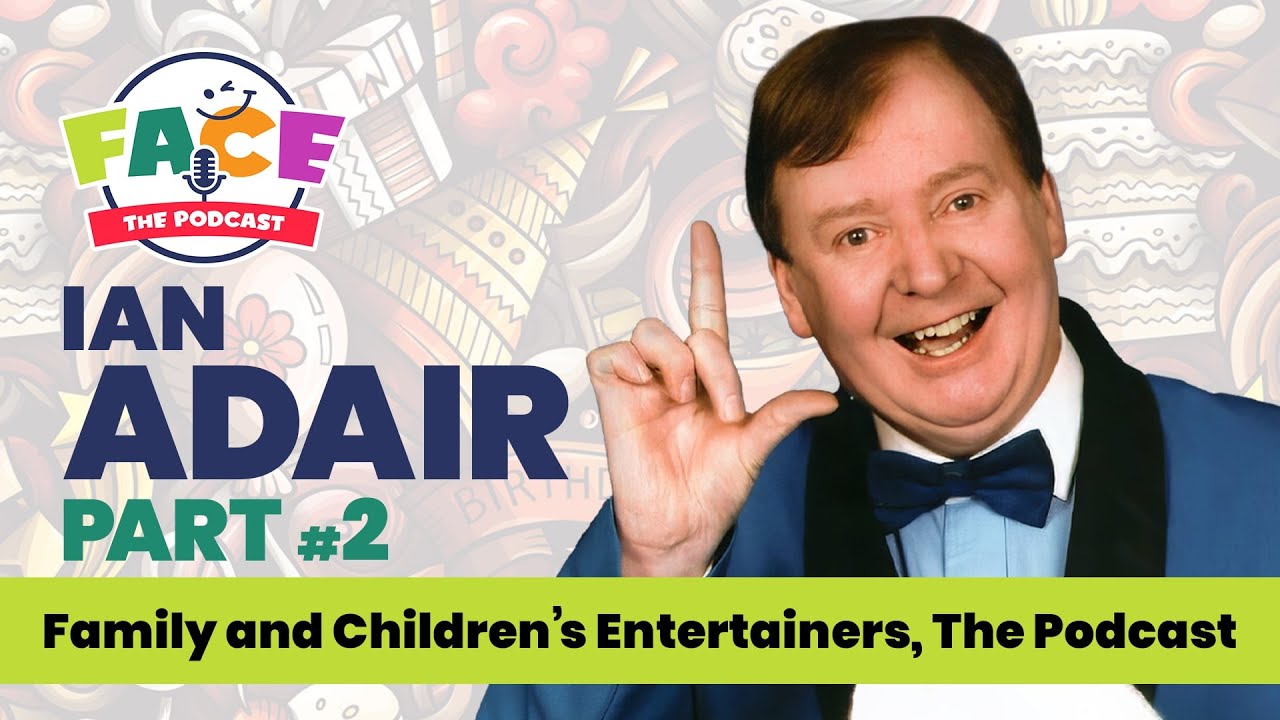
Hello, and welcome to this episode of Family and Children's Entertainers: The Podcast, better known as FACE: The Podcast, which is a podcast and a vidcast about children and family entertainers, about what they do and how they do it. My name is Gordon Drayson, and I am a full-time children's entertainer. And the reason for setting up this podcast and vidcast is to shine a spotlight on those people who go out and earn their living performing for families and children. I feel we're very much under looked by the magic community and the community of entertainers in general, and I felt it was important to understand them and to show what we do and how we do it to everybody else. Today's episode is part two of my interview with Ian Adair. Now, for those who didn't listen to the first episode, go back and listen to that because it was very, very interesting. For those who do know, Ian Adair used to work with Supreme Magic Company, the biggest magic company in the world at the time. This is part two. Now, in part two, I talked to Ian about the Supreme 'Magic Days' or 'Super Days,' as he called them. We also talk about the simplicity of the actual magic effect, the prop design and how it can be made to work better. We talk about brochures and websites. We also have a little bit of an anecdote about fun with sat navs, which are something that Ian didn't really get on with. I also talked to Ian about how he creates new effects and what he is most proud of, having created thousands and thousands of effects over the years. He also tells me how he wishes to be remembered when he is gone. Well, let's hope that's a long time from now. Without any more talk from me, let's get straight into it and go back to part two of my interview with the legend that is Ian Adair.
[00:02:27.960] - Gordon Drayson
My first ever experience of a magic convention was a Supreme Super Day in Lewisham.
[00:02:37.010] - Ian Adair
Super Day?
[00:02:37.800] - Gordon Drayson
Yeah.
[00:02:38.610] - Ian Adair
Oh, yeah.
[00:02:39.370] - Gordon Drayson
Yeah. I remember vividly. Your star guest was David Berglas. First time I'd ever seen him. He did a whole lecture on esp-acology, which was his basket of fruit prediction, if you like, which was amazing. I remember I was with my dad. It was very shortly after I'd got my first roll on and so I was still a teenager at the time. I remember sitting before David Berglass started, and I looked at the gentleman who was sitting next to me, and I gave a double take and I said, "Huh. You wrote my favourite book on Children's Magic." He said, "Oh, that's very kind of you to say." And it was a gentleman called Peter Darcy, and he wrote Children's Parties A Speciality which...
[00:03:32.850] - Ian Adair
Published by Goodliffe.
[00:03:33.770] - Gordon Drayson
-published. Yeah, exactly. It was one of my favourite children's books at the time because I loved the idea of how he'd got his whole show in one big prop and it built up. There were different acts in the book, but there was one with blocks of letter blocks, children's playing blocks, and you would take things out of the blocks and you'd end up making them into a big castle. At the end they'd be a Bunny Rabbit. I just loved that idea. I've never done it, but I thought the idea was great.
[00:04:06.840] - Ian Adair
Yeah, great. It sounds terrific. Of course, way back when I was hunting for books for Children's Magic, there weren't any... The first one that came out was published by Goodliffe, Open Sesame by Eric C. Lewis and Wilford Tyler, a hardback. That was marvellous. Over the America, Frances Ireland Marshall brought out a series of Kid Stuff books. Number 1, 2, 3, a little bit Americanised. I got one or two of these. I couldn't afford them, but I did get. Now, there are things in the Eric C. Lewis books. A lot of them you couldn't use today. School or circus. The teacher saying, "Now, children, what would you prefer? School today here or I'll take you to the circus. The circus. Let's go to the circus. I've got some animals here. Here's a lion, an elephant..." Which you never see at circuses anyway. But no teacher at school does that. And the school was a little school with a little bell at the top. A village school that had six people in it. There's a lot of things that, as we mentioned before, you can't use. But that was my first one. Goodliffe have brought out Fred Barton, a great friend of mine, Land of Make Believe, dressing up again, which you cannot use that much today. You can. You can put a chef's hat on a girl for baking a cake, but fiddling about with aprons and doing this and that and putting things around. It's a little bit difficult. But his book was full of that, Fred. Goodliffe did print one or two books on children's magic. It's great.
[00:05:59.940] - Gordon Drayson
So as well as getting the books on Children's Magic wherever I could, the staple for me, for my magic fix, if you like, for my magic learning experience was to get magazines. And so I subscribed to and got The Magigram and The New Pentagram, which were both produced by Supreme. In fact, I currently have every issue of both of those and The Magigrams, I bought the old bound volumes as well from before when I started receiving them. They were all used to be bound up in these big black binders, which were beautiful.
[00:06:45.070] - Ian Adair
Yes.
[00:06:45.920] - Gordon Drayson
Along with those, I also got the Club 71 magazine and Abra, both of which I understand you wrote for as well.
[00:06:54.720] - Ian Adair
I used to write for the Club magazine, which changed its name to The Magician in the end. You've got Ali Kadabra, he had a column in there as well, and I did every month there. Abra, I must have been in hundreds of Abras over the years. Right to the very end, the last one that came out, I had an item in there. So I'm pleased about that. When it folded, I was in there. But yeah, I never got paid for any of these. We got credit notes. We could buy books or extend our subscription.
[00:07:32.950] - Gordon Drayson
I remember-
[00:07:33.770] - Ian Adair
You'd never be a rich man being a magic inventor.
[00:07:38.350] - Gordon Drayson
No. I remember looking forward to reading Henrique's articles about how bad children's entertainment was.
[00:07:47.040] - Ian Adair
Yes. He used to run himself down in his articles.
[00:07:50.080] - Gordon Drayson
He did, all the time.
[00:07:52.060] - Ian Adair
Some of the dreadful things that happened to him during the show. I often wondered if these were true life or if it was just made up.
[00:07:59.060] - Gordon Drayson
Me too.
[00:07:59.680] - Ian Adair
Just to make an article, but yeah, a lot of people liked his stuff. And he did write in several magazines. I don't know if he was a children's entertainer, was he? I don't think so.
[00:08:11.750] - Gordon Drayson
No, I think he was. I'm pretty sure he spoke about all these nightmares he had at children's parties. I think maybe he was just trying to put off anybody wanting to start doing children's parties in his area. That's probably what it was.
[00:08:25.270] - Ian Adair
I forgot to tell you my very first real children's magic trick, made for children, was from Supreme before I joined them, still in Kilmarnock, "Toy Town Painting." Roy Danley's, Toy Town Painting. A flick painting book long before all these ones with blank pages and stuff here. A Tarbell Cone, which came in handy for other tricks, eight silk hankies 12-inch; 12 and sixpence, just more than 50p today.
[00:08:59.390] - Gordon Drayson
Wow.
[00:08:59.690] - Ian Adair
Post-free.
[00:08:59.690] - Gordon Drayson
Yeah, Post-free was a big thing with Supreme.
[00:09:01.620] - Ian Adair
Don't say... Oh, that was then. Even then, everybody thought that was great value because you could use the silks again for other tricks. The Tarbell Cone you could use many many different times. The flick book, of course, was only made for black and white to colour, but that's all you needed. You don't need it to be errors in the book, where the paints- or blank pages to start with and things like that. You don't really need all that, but that's gilding the lily a bit. It's another prop to sell and these are available today. But that's it. I thought I'd mention that one. That was one of my first ones that I had.
[00:09:44.090] - Gordon Drayson
We'll touch on the inventing side in just a moment, just to finish off our Supreme journey. They sadly shut down in '93, I think you said. Was that because of the change of management or the changes in the world? What caused them to go from being such a huge empire down to closing?
[00:10:12.910] - Ian Adair
Well, it's a long story, but I'll be very very short. It's a bit about everything you've said there. Edwin was diagnosed with cancer and was given four years to live, and he was working at Supreme. Now, when you've got four years to live, I don't know how long I've got to live and you don't know yet. I don't know yet. You can't say, I would have done that. Now, you can't say that. But when you know that in four years' time, you're going to die, you're going to wind up your life. You know that you want to do as much as possible. Now, Supreme Magic Company was a very difficult firm to sell. I told Edwin years before, "It's too big. You've made it too big. You've made it so much so that some of the smaller dealers would never be able to afford it and you'll get no outsiders outside of Magic going to be interested in it because it's a specialized business." Obviously, it had to go on the market. I couldn't buy it because I had four divorces, very expensive ones. I had no money and it was up for sale for a lot of money. All the buildings were owned by Supreme, not rented. All the vehicles, two or three vans, the machinery, the print department, all the print machines, four of them, the guillotine, the sewing machines for sewing up the stitchbooks, they were up for sale. Along came Paul Dupay and Brian Head, two people who didn't really know one end of a magic wand from the other, but they were businessmen. They had business qualities. They said to Edwin, and as long as I'd stay on, they'll buy the firm. Now, I could have turned around and said, "No," I could say "I want 10 times the amount of money" because I had the... I was one up there. In the end, they took over. Now, their years, four or five years, they brought out a lot of things. They brought out Alakazam magazine for Children's Magic, the video section of 23 different personalities, Carl Fox, etc, all these people, brought out all that, the Encyclopaedia of Children's Magic. They brought out the, continued the Magigram. They did quite a lot of things during their time, but then they wanted to sell and go on to something else. That's what these business people do. And along came someone else knowing that it was up for sale. I'm not going to mention any names here because I never mention this person's name. I never run them down. I never praise them. I don't have anything to do with them at all. Let's put it this way. In the Repro magazine, I think, Jeff Busby, is he called? Is it Jeff Busby?
[00:13:03.660] - Gordon Drayson
No.
[00:13:05.460] - Ian Adair
No, not Jeff Maltby. He said in an editorial, It took Edwin nearly 40 years to build up his business to see his baby strive, and it took two and a half years for this man, naming him, to destroy it. That's what happened.
[00:13:25.590] - Gordon Drayson
Wow. Such a shame.
[00:13:27.790] - Ian Adair
One by one, we saw people go from the firm and I was dismissed as well.
[00:13:35.860] - Gordon Drayson
When you left Supreme, did you then go full-time performer?
[00:13:40.650] - Ian Adair
Normally, you see, during Supreme Hours, I couldn't do shows during the day, but to be honest, there weren't a lot of parties during the day. Children are at school, adults at work. Mainly it's weekends or evenings. So, I had a summer season every night at all the coastal places, Ilfracombe, Woolacombe, Croyd, every single night, 22 weeks a year, every night; selling stuff after each one, 100 magic bags after each one, people clearing up. I did all that. Left the business around about 5:30 when we closed each day, travelled down. I was there by 6:30. By 7:15, I started the show. So I did all that, you see. There was no reason for me to not do shows. And I also wanted sometimes to take an item that's new and break it into a show and see how it registered. So that when I'm demonstrating it at magic conventions, I could tell people I've done this in front of audiences and it goes well. That was another way of doing it. But at the end of the day, I'd say yes, it was not managed well at all.
[00:14:54.830] - Gordon Drayson
That's very sad.
[00:14:56.490] - Ian Adair
I'll just put it down as that. Everybody lost their jobs. Some of the Magic Dealers, one or two, were interested but only wanted to buy certain props. Not all the props. Davenports was one. Only certain props. Davenports didn't want to leave London and take over the firm and staff down in Devon. Neither did any other dealer. So it was all split up. Magic Books by Post got the books. The props went to Wales to Paul Anthony. Buildings were sold commercially and now are insurance offices and a furniture store again. Vans could be sold anywhere. That's how it all split up. And I went full-time. I always looked upon myself as a professional because you can have good amateurs who are professional in their outlook, better than some people that say they're full-time professionals. That's only because they're doing nothing else. Then you get these people who are retired from a job in the bank at 58, and now they've become a full-time professional magician. That's on their card. It says so. But they've never been a full-time professional magician before that. All this 'professional' business, Cedric taught me that. He said Cedric Richardson was a great mentor of mine. He said, and he was the one that really taught me a lot about children's magic. He was the man that got me a lot of shows. Not in Devon, but different ways to get shows. So there we are.
[00:16:39.430] - Gordon Drayson
You mentioned your mentors there. Do you want to tell us a little bit about why you had a mentor, first of all? Because it's not something that I think people do today, and I think they should because I think getting the experience of someone who knows what they're doing can save you an awful lot of time.
[00:17:01.220] - Ian Adair
It's another thing that's changed. And, of course, a mentor can watch you perform like a producer and say, "No, Ian, use your left hand. Ah, that's better. You were covering... Don't pick it up there. Why have you got it on the table for a start? Have it underneath. It's a surprise when you bring it." If you're doing it all on your own in front of a mirror in the bedroom and you put the things on a bed, got that bedroom where you have your venue. But no, Cedric Richardson was very good for me. I got to know him, met him at The Magic Circle. We had an interest in children's magic. He was doing nothing but children's shows, nothing else, and working at airports and all sorts of things when there've been breakdowns for flights and all that. He used to be there four or five days, entertaining crowds of people who were waiting for planes and all such, as well as children's parties. We got together and he stayed with me in my house and I stayed with him. He used to advise me. I said, "Ian, of course." He said, "One thing that most Children's entertainers don't think about," and we're going back years ago, "is FAP." I said, "Well, I don't know what you're talking about." "F-A-P." I said, "Well, I know FAP, how you spell it, but what is that?" He said "it's full audience participation." I said, "I like audience participation." "Yes, you get the birthday girl up on her own. You say, That's lovely. Give her a nice clap, everybody. But not everybody's been involved in that trick, have they? Or even if you go to an ordinary party, you pick a little Johnny there, come right up there and do the trick. That's marvellous. Here's a magic wand. Clear off." You don't say that, of course. But the thing is, he was right. He had tricks where he involved everybody in the whole audience. When they went home, "Mummy, Mummy, Mr. Magic, he made us all do the magic. Can I have him for my party?" "Do you really want to?" "Yes, he's very clever. He made us...." One of the tricks, which I showed him and he liked with FAP is, "Hello, boys and girls. Well, I'm a magic man. To be a magic man, you've got to have three things. You've got to have a magic wand, you've got to have a magic spell," and then I'll go through the magic spell, "and you need some magic fingers. And I've got magic fingers. I've got them on both hands, actually. You've got magic fingers as well. Can I see them?" Now, this is where the FAP starts. They all put their hands up. "Marvellous. Well, that's it. Wiggle your fingers, wiggle your toes, wiggle your nose, ooh you look like Bugs Bunny with a twitchy nose. Now, copy me. Right, show your hands empty, wave them in the air, make a butterfly." Now, I've got a thumb tip here. Isn't it amazing? You can stop there. "Make a butterfly, let it fly. Now, here's the real magic. Copy me. Use your magic fingers. Catch and reach inside and bring out a nice red-coloured silk hanky. Isn't that marvellous? Hold up your hankies. Where's your hankies? Well, that's because you're not real magic men. But I'll teach you later." And that's it. That used to get me, get everybody involved. You told everybody you had a magic wand. You told them you had a magic spell. My magic spell wasn't Abracadabra. It was Abracadair. I had the adults at the back, Adair, Abracadadair. It sounded like Abracadabra. They all shouted, Abracadadair. They were shouting my name.
[00:20:51.850] - Gordon Drayson
Perfect.
[00:20:52.500] - Ian Adair
By the way, I never called them silks. It was always hankies. I see a children's entertainer the other month. "Now, I've got three silks on the table. Would you pick up which colour silk you want?" And the boy didn't know the hell what he was talking about. It's a jargon from magicians, from magic dealers, things that you buy. Yes, they are silks. They're silk squares, but call them hankies. That's what they are. They're for blowing your nose, it doesn't matter what colour they are, but they're not silks. It's like decks of cards. Shuffle this deck. They're packs of cards. Way back years ago, there's a pack of cards. Now these youngsters, "take the deck and give it a shuffle." It makes me laugh. I still use the word pack and I still use number one, Waddington cards, because that's what is common in all the shops here. I don't go around all my shops and see bicycle packs. I can't see them in the shops where I go. I like a design that people know. Yeah, it's Bridge size, I don't care. They're quite cheap and I don't want to go around saying "I use bicycle cards because that's what all the magicians use."
[00:22:08.560] - Gordon Drayson
Yeah, of course.
[00:22:09.320] - Ian Adair
Or do you disagree, Gordon?
[00:22:10.620] - Gordon Drayson
Well, I only use bicycle cards because they're easier to handle.
[00:22:14.570] - Ian Adair
Well so do I. I use bicycle. I do. I do now. Because a lot of the fake cards are with bicycle.
[00:22:22.210] - Gordon Drayson
Yes, that's true. That's a good reason to use them. I like your silk appearance there. I quite like the idea.
[00:22:31.560] - Ian Adair
I said I wasn't going to perform anything.
[00:22:34.120] - Gordon Drayson
No, I know and I wasn't expecting it.
[00:22:37.110] - Ian Adair
I managed to pick it out and I've said, "How could I do it when I'm sitting down? I should be standing up." And you've got all the children and you're moving from one side. I like to move around when I'm on the platform at a village party. They always say, fill the stage. Don't just be static. Even at a Children's Show, "lovely to see you. Hello. Your magic fingers are not, that's it you're much better." Acknowledge them, even though you're not pointing to anybody and don't point to anybody. "That's it. Now, wiggle your fingers. That's it. Keep them going. Oh, you're not wiggling. That's marvellous. Now make a butterfly." I like the butterfly because we went through waving our fingers, "wave your fingers, make the butterfly and pause, make it flutter." They're all doing that. They're not thinking, "he's got a thumb tip behind that thumb or a silk hanky." Oh, I said hanky. Yes, you can say a silk hanky. A beautiful silk hanky. And by the way, all my silks were diagonal or triangle.
[00:23:39.920] - Gordon Drayson
Because it makes them look bigger.
[00:23:41.030] - Ian Adair
You get it inside a thumb tip. I hate these magicians that bring out a nine-inch silk hanky from a thumb tip.
[00:23:47.580] - Gordon Drayson
I like your your idea there as an opener, a warm up. And also as you were doing it, I was thinking it would be great if you did the magician look don't see thing. You show the handkerchief and then you put it back into your hand and it disappears and you say, "Let's see if everyone managed to-"
[00:24:09.060] - Ian Adair
Oh, yes.
[00:24:09.880] - Gordon Drayson
"You all managed to make it disappear."
[00:24:12.410] - Ian Adair
You could do that. And of course, you could... Yeah, you could make it into... That routine is in my Encyclopaedia of Children's Magic. It's in there.
[00:24:21.660] - Gordon Drayson
Which is a huge tome, 400 pages. It's huge.
[00:24:25.270] - Ian Adair
Yeah, 400, nearly, I think. Yeah, it's in there. If anybody's interested, there you are. It's explanatory, really, what I did.
[00:24:34.920] - Gordon Drayson
Yeah, but it's so simple.
[00:24:36.380] - Ian Adair
It's simple using a thumb tip.
[00:24:38.190] - Gordon Drayson
Yes.
[00:24:38.960] - Ian Adair
Yes. But I was never one of these children's entertainers who would come out on the front. "Now, before the show starts, boys and girls, I'd like everybody to sit down" and let's say, "I don't want anybody to go over this rope here." I never had a rope or "that chalk line. The teachers at the side will be very naughty if you..." None of that. If I wasn't introduced... At holiday seasons and I had them every night, I had a DJ record six different tapes with music backgrounds like Magic. It's Magic. It's Magic. You know, Fred Mercury? It's Magic going in the background. Magic. Magic. "Ladies and gentlemen, boys and girls, give a big welcome for your man of magic here today, Ian Adair." Then I'd come out. Well, it used to be a string curtain and I'd pull that and it would come there and I'd come out. "Hello boys and girls!" That's how I would do my entrance there if there was no one there. And a lot of these holiday camps, they didn't have a compere ready for every show just like that.
[00:25:48.780] - Gordon Drayson
Yeah, first impressions are very important.
[00:25:52.190] - Ian Adair
Yeah, I always think so. Someone said to me, a magician who called at Supreme and saw me during the night doing a show at one of these venues, "My goodness, what a lot of props you've got on the stage? I just have one little case." I said, "Yeah, but I brought along a show. You just brought along that little case, haven't you?" And he didn't like that. And Blackstone in one of the magazines says, "Give them something to look at. You're a performer. Have a rabbit, have this. Don't just come along with a pack of cards and a little briefcase. We could all do that." When my show was set up, I had a back cloth unit, I had sparkly curtains, I had two lights, one at each side, it was even made it more sparkly. I could set up behind there. Afterwards, I could put my main stuff behind there so nobody could get at it. I had two settings, a box table and something else because I like to do these tricks where it travels from there to there, even Hippity Rabbits. You know what I mean?
[00:27:02.200] - Gordon Drayson
Yep.
[00:27:02.440] - Ian Adair
I had all that. I had an amplifier. I had all these things. My name was on one of the tables. So when Mrs. Jones, who came to the village hall, I was there before her, came in and she said, "What a lovely..." She's paying for this show. "You've gone to a tremendous lot of trouble, Mr. Adair. What a lot of very... Oh the children are going to enjoy this. Mavis, look at this. Look at all this. This is marvellous. Look at these curtains. Oh, yeah, I'm a dressmaker. These are beautiful. Isn't that lovely? I like that."
[00:27:39.790] - Gordon Drayson
Yeah, I agree. You're making it more of a theatrical experience.
[00:27:44.320] - Ian Adair
Yeah. There's some people that might just say to me, "That's all right for you, but I do have a little case and I open it up and I call it my magic case. And from it, I'm very clever. I can do my whole act for an hour there." I quite agree and I quite respect that. It's quite good. I'm not running anybody down. I never run anybody down. I never run any children's entertainers that I've watched that I thought was poor. I've never run them down. I've never given them any actual guidance of where they went wrong unless they've asked. I wouldn't say, "Oh, by the way, I would do it this way and that way. I noticed you did that." I did tell someone at Pontins, I was right at the very back and I came round, I said, "Do you know, I couldn't see any of the pictures." He said, "Well, that's Supreme's fault because the pictures are not..." I said, "The pictures are this size." I said, "But there's a thousand people here, adults as well." I said, "You go to the London Palladium and you hold up a little picture." He said, "Well, Paul Daniels did it at the Prince of Wales Theatre and he held a walnut." I said, "Well, that's a different matter. They knew it was a walnut because they asked the man, What's this? It's a ball of walnuts." When you're recognizing what's on a picture, and you don't want much detail on if you're ever doing pictures, don't put wrinkles on their faces and shadows and things like that. Or if you don't really need a full size picture of a man, cut his trousers and that, just his head with a little body like 'Farmyard Frolics.' It's got the big head of the pig, a big head of the donkey, a big head of the cat. So you can see that that's a cat, that's a dog. Not like a little with four legs.
[00:29:44.750] - Gordon Drayson
Yeah, less is more.
[00:29:46.030] - Ian Adair
None of the children would see them.
[00:29:48.970] - Gordon Drayson
Yeah, very wise words.
[00:29:50.840] - Ian Adair
That's where all the design comes in. That's where we used to sit behind the table and say, No, we didn't say to the silk screen man, do a picture of a rabbit on there and it would come out not what we wanted. It'd probably come out with like an ordinary rabbit you'd find in a field with sideways, not upright, not in a hat or anything like that. You've got to do rough drawings or show them this, that, and the other. I want it to bleed off the card. I don't want a border around the card because when there's a turnover, that would spoil, it's better if it just blew right off the edges. So we knew what magicians wanted and what we wanted to sell, even though perhaps the silk screen man didn't quite know until we told them. That's where a lot of magicians go to printers, "I'll leave it to you," and they get their brochure or that, and it's not exactly what they want.
[00:30:46.170] - Gordon Drayson
Yeah. I agree.
[00:30:46.870] - Ian Adair
But they don't have brochures anymore. I don't think brochures are used, are they?
[00:30:50.080] - Gordon Drayson
No, but they do have websites. You go to a website builder and I build websites for people.
[00:30:54.480] - Ian Adair
Yes, I know. Do you call that a brochure? You don't call a brochure a Website.
[00:30:57.920] - Gordon Drayson
It's not a brochure.
[00:30:58.740] - Ian Adair
It's not a brochure, is it?
[00:31:00.570] - Gordon Drayson
It's an online presence, isn't it? It's your information.
[00:31:03.790] - Ian Adair
And yet I saw an advert for a liner going ride a cruise, "send for our brochure."
[00:31:10.570] - Gordon Drayson
Anything that's high priced has a brochure.
[00:31:13.980] - Ian Adair
What's that? That food company get you meals farm, something farm would, "send for our brochure. Send for our brochure."
[00:31:22.040] - Gordon Drayson
Anything that's high priced has a brochure.
[00:31:24.150] - Ian Adair
Still around.
[00:31:24.430] - Gordon Drayson
If you buy a car, there'll be a brochure for that. There's still cruise liners. They will have a physical booklet.
[00:31:34.610] - Ian Adair
I don't think Argos do catalogues anymore, do they?
[00:31:37.790] - Gordon Drayson
I think they do in store. I don't know if they-
[00:31:42.210] - Ian Adair
Don't you have to go out to the screen and-.
[00:31:45.420] - Gordon Drayson
Maybe, yeah. Last time I went, which was a long time ago now, they had laminated pages and you typed in the code that you wanted on the screen, but I don't know.
[00:31:55.380] - Ian Adair
I never had a website ever.
[00:31:57.970] - Gordon Drayson
No.
[00:31:58.700] - Ian Adair
For shows. Never. It was all done by telephone. "Yes, give me your address. Thank you there. I'll confirm that in writing." I used to send them a brochure that says, I hope you enjoy my magic show. Here's how the party should be, not telling her what to do, but this is the best result. If there's lots of balloons around, get them out of the way before the entertainer comes. It distracts them. If there's this, that, and that, all that, it was from my advantage. But I would send a little card in saying "party booked for Saturday 3pm at the village hall." I made a mistake once. I went to the village hall, parked there. They said the janitor will be there to open up. I was there early. I was always early. Time was getting on. It was nearly three o'clock, or was 2:30, panicking. I stopped someone on the street. I said, "Where's the janitor live in this village hall?" He said, "Which village hall?" He said, "This village has got two. There's one down the road." "Oh, now, he tells." The person didn't tell me that. So I drove down there and they're all waiting for me. Later on, I learnt a lesson. Any place I went, and this is only a small village, and she called it a village hall, but it's called something else. But this one was the first that came to you and it says, Village Hall. What would you do? You'd drive in there. There was no satnavs.
[00:33:39.200] - Gordon Drayson
It's funny you say that. I have a friend of mine who's also a children's entertainer, and he saw my satnav. I've had a Satnav for like 20 years now, and he saw mine and he thought he would get one for him. First weekend he had it he typed in so and so hall, and he looked at it and it was telling him to turn left and he was going, "No, that's a rubbish way. I'm turning right. I know where this hall is." This is why it's a good test. He followed. He went where he wanted. All this time, the satnav was trying to take him a different way. He got there, he set up, and then found out afterwards that there's two St. Christopher's Halls in this town, and the satnav was trying to take him to the correct one.
[00:34:25.480] - Ian Adair
When I went to Trix in the Stix with Steve Shaw. He drove his vehicle to Jeremy's house because we're invited for a meal there. He said, "I've got a satnav." He switched it on. Heaven's above, we're round down little lanes. We had to reverse to let cars come up. There was cliffs. If you went over there you'd... All round about, miles. We got to him. We said, "Well, it took us an hour." He said, "It's a five minute, two minutes down the main road. Did it tell you?" It told us to go the wrong way, a different way.
[00:35:05.390] - Gordon Drayson
They have got much better now.
[00:35:07.510] - Ian Adair
Have they? Well, that was years ago. That was the first Trix in the Stix.
[00:35:13.220] - Gordon Drayson
Right, amazing.
[00:35:14.190] - Ian Adair
I had a stall there with all my books on children's magic. I did the first Kidology. I was the first lecturer there. I'm jumping the queue. I don't know what you're going to ask.
[00:35:24.830] - Gordon Drayson
We'll be back with Ian Adair in just a moment. First of all, a word from our sponsor, which today is a project that I created with my good friend and colleague, Paul Longhurst. This is called Booking Blueprints School Edition. Paul and I put together this package that goes through in detail how you get midweek bookings at schools. So it basically is looking at how to get shows with PTAs. A lot of schools have discos after school and they make money from it. It's a money-making scheme for the school. So we looked at the shows that we do for schools and how you can go about making bookings with PTAs for shows during the week at schools and boost your income. And what we did is we tested the system many times over. We put together a package with the complete blueprints. This includes absolutely everything you need to take the bookings for the show. So it goes into depth about having a meeting with them, what to say at the meeting, what emails to send, how to approach the schools in the first place, and everything up to the point where you actually get to the show ready to perform your children's show. There are no tricks or presentations for schools in this package. It is merely the marketing tools you need to get the bookings. There is a discount available for people who listen and watch FACE: The Podcast, and you can go to bookingblueprints.com and use the code FACETHEPODCAST to get 20% discount. This is a package that you can use over and over again and it will bring in many thousands of pounds with midweek bookings. The ideas that we use here can also be used for other types of shows as well. So go and take a look at bookingblueprints.com and don't forget the discount code FACETHEPODCAST, which will run for a period of time after this podcast has been released. Right, that's it from me. Let's get back to Ian Adair.
[00:37:58.950] - Gordon Drayson
We haven't touched on, and this is, I think, what you're probably best known for, and that is inventing and coming up with ideas for magic and publishing books. I mean, you've had thousands of tricks that you've invented and thousands that have been marketed, plus your 331 books as well. Let's talk about that then. How do you come up with all these ideas?
[00:38:26.790] - Ian Adair
Well, it's all discussed in this book, which I wrote called Thinking Tricks, a very poor seller. I'll tell you why. Not many people want to think up their own tricks. They don't want to make up their own tricks from the magazines. They want to buy the tricks from the dealer. The number of people with notebooks at lectures, "that's good." The person tells you how to make it, but they never use them. But no, there's different ways to invent tricks, and I don't like using the word invent. I don't call myself an inventor. I call myself an originator or creator. If I had a routine with a thumb tip and it was my idea, I wouldn't call that an invention because I didn't invent the thumb tip and I didn't invent silk. You hear people say, "I invented this." But when you see it used a card box that's invented before, yeah, he's added something to it, but it's not an invention. But anyway, there's different ways and we all have our different ways to those who do it. I look mainly, especially now, for tricks that can be marketed, meaning they're suitable for performing in front of audiences, including children, but they're past the magazine stage where someone says, "Oh, I can make this. You only need this, that and that. I've got that at home." But this product I cannot make. It's made it in wood and plastic and it's for sale. So I try to make things if it comes up the idea and it's a good idea and it's not suitable, I know to send to Sam Delal in India, who's manufactured nearly 1,000 of my items over the years. I've had a lot rejected. A lot. Maybe 1,000 rejected. "Sorry, Ian, this is not suitable for... We haven't got the people to make it or it's not worldwide. I can't sell it. It's too British," all that stuff. At the end of the day, I'm careful. If it's not a market, I'll write it up for a magazine for the Key Ring for the column that I've been doing for 25 years. The Kid's Corner. And I keep asking for another year. I still don't know who the editor is yet because I think, Maskell is not the proper editor, but he's doing a good job at the moment. It's very good because Jeffrey Newton's handed it over, but he still seems to do a lot of writing for the magazine. I notice that. But yeah, I'm into that and I write things for Magicseen, but there's different ways of doing things. You can start with the effect, which is a good way of doing it. That means you can start with something completely different that's not been done before, rather than starting with a principle, that's been done before. Unless you have a new principle. But you can't have new principle. There's only eight to nine principles. You can't call new technology principles. Yes, you can use things digitally because they're now available, but they're usually just in place of something else. You've got a clipboard that's got something inside it that tells you, Now you don't need to use the carbon paper anymore. So it's different, but they're using it in a different way. There's ways of doing it like that. There's ways where you can go around stores and see toys and things like that. "That's good. I can adapt that into a trick," and it works. But then it can't be a marketed thing because these things, toys, are not available on the market. They're available wholesale through toy places that sell them by the thousand. Some of them, actually dealers, don't make a thousand. They make a dozen of this, a dozen of that, 20 of this. We'll see how it goes. You can do it that way. But individually, you can do it that way. That's quite good. You can also create tricks where you've seen a trick before like 'Farmyard Frolics.' How many versions are there of Farmyard Frolics? There's one with zoo, there's a pet shop one, there's one with wildlife, there's one with everything. They're not direct copies, but if Edwin Hooper hadn't have brought out Farmyard Frolics, that wouldn't have existed, these ones, because it's very easy just to change the pictures on the cards and a new theme, a pet shop or a wildlife or a zoo and or the front of a farmhouse instead of a zoo house. Very easy to do. That's another way of doing it. At the end of the day, the average magician doesn't want to go to that expense and that time of making up a trick like that. And just hoping that a magic dealer will come out with something that's based on, and Edwin doesn't always get the credit, 'based on an idea of Edwin Hooper's.' By the way, here's something interesting. For you children's entertainers out there. I did ask years ago, Edwin Hooper, "Where, when did you get the idea of Farmyard Frolics?" The most sales of any trick we can ever think of certainly with Supreme Magic. Thousands and thousands over the years. He said, "Well, I went to a farm." That's a good joke. I said, "You invented it in the farm?" "No, no. I saw a lot of cows and sheep and then meeh, moo, baa. Pigs, pig snorting." I can't snort. Yeah, that's it. He said, "It's a friend of mine. When I came home, I had a bath. I was lying in the bath," he said, I thought, "That's quite interesting. All these noises, getting them all mixed up. A sheep goes meeh, Is that right, boys, and girls? No. That's good. And they had a cat there. They had a farm cat. And he's the one that's the magical one." And that's how it came about. Amazing, isn't it?
[00:44:49.510] - Gordon Drayson
Edwin Hooper in the bath. That's how it came about.
[00:44:52.100] - Ian Adair
Yeah, that's right. And there we are. Inventing tricks. Some have said, "What's the real secret?" Well, there's no real secret. You've either got it or you haven't. Not everybody can do it. I mean someone said, "Can you write a pop hit for me?" I said, "No. I'll learn how to do it." How am I going to teach you how to do a best seller? Number one record? No. Sometimes you get people who are honest. "I'm very good at routines. Once I get a prop that I bought, I can put it together in a way I like and it suits me." Good. And do that. That's the right way of doing it. Don't do like what others do. Some of them, quite a lot. "The minute I buy a prop from the dealer, I crush the instructions, I throw it in the bin." No! The dealer and the inventor have taken time. Sometimes four or five pages with Supreme Magic. Davenports used to only have one page. I'm not running Davenports down. I got some of my first tricks from there. Very good. Study exactly the workings of the trick. The suggested patter, what they think might go down well. It might not suit you, but then after that, keep the instructions on file. You might want it again just in case after five years you've forgotten the working method or the suggested patter or all that, and you might want to sell it again, so it's better with instructions. In the end of the day, you've got to put your own personality into it by all means so that it's different from everybody else's. Some of the jokes and suggested patter might not be any good, but that's it. Inventing is very much like you've got so many principles, you can use them. You can see, now, paddle tricks. I must have had about 40 or 50 marketed, a lot by Sam Delal, some by others. It's still paddles, but some of them are sticks. Some have round paddles on the end, some are cut like fish, but you've got a tail that you can hold. Some look like cricket bats, but it's still the paddle move. Who invented the paddle move? Nobody knows. We're still hunting for a name. Someone did. I've asked everybody. I asked Max Maven, when he sadly passed away, he couldn't say. Alan Shaxon didn't know. Pat Page didn't know. Ali Bongo, he didn't know. Nobody knows. But anyway, the thing is you can... Like the trick where you've got anti-gravity glasses. I must have about 12 different versions. They're all done in different ways. I've taken a trick that's already invented, originated, sorry. Already originated and I've got a different way of doing it. Sometimes that can improve it, sometimes it can't. It's just no reason to improve it. Sometimes it can improve it to the extent that I could take my hand away, which you couldn't do before. You can have something that makes it even more baffling. That is another thing, is taking an already available trick, created by someone else like the Banknote tray, in 'Just Chance.' There must be hundreds of different versions of getting that note into the envelope or someone opening this and there it is. You've got the one that's... Or the even for Children's Magic, I've created a few where the child gets something at the end and you're left with nothing, but you've got to change it. But there's different ways of doing it. But I think you've got to know a lot about what's been invented before. If you don't, you'll never be a magical creator. Because you might be inventing things that have been thought of years ago. You might be coming up with, you might upset people by putting your name on something that maybe a magazine didn't realize was someone else's. And someone says, "That's mine, invented 1948," and you're coming out with now something new. So there's different ways of actually inventing. I do it my way. I think the book should have been called Inventing Magic My Way, but I don't think it's a good title at all. But Thinking Tricks, it tells you how some of the other magical people thought up tricks and how they came about. It's an interesting book, but I don't plug it anymore. I must have about 400 here that's not sold. They're taking a... But I can't, unfortunately, go into Tescos and say, "Instead of money, can I give you 400 of these books? I'd like a few groceries." They won't take it.
[00:50:07.950] - Gordon Drayson
No, it's very sad.
[00:50:08.170] - Ian Adair
I can't even say, Well, I'm Ian Adair, a creator of magic - they couldn't care less. But the thing is, I love inventing magic. I love sharing ideas with people. I don't keep anything at all for myself. I'm not like these people saying, "This is my idea. I never share it with anybody. It'll go to my grave. I don't want anybody to know." Why? When he's gone, it's done no good. It really isn't. This is about hand things down. If all these people before us had to have done these things and left these things for us, we wouldn't have been here today doing them. We've got to thank them. We don't have to thank them personally, most of them are dead. But we can say to ourselves, "Well, if it wasn't for you, we wouldn't be doing these now." A lot of magical inventors I love, like Jack Hughes, U. F. Grant coming up with the screen that you show all sides. It used to baffle me and the magic carpet where the girl sits on the carpet, comes up. The other levitation Miracle X, came up with marvellous ideas as well as small ideas. A lot of people coming up with tremendous ideas. They have different ways of coming up with them. They've never really... A lot of them have, when they've sold their businesses, a lot of these people, inventors have been magic dealers, but a lot of the magic dealers are not creative at all. Mainly the ones who, over the last 20 years, have come into magic by buying stocks of items through Murphy's Magic Company or through Robbins of America, a dozen of this, a dozen of that. Sam Delal is a wholesaler, and he sells to these firms, Joke Shops as well, magic shops. He doesn't sell singly. If you wanted a something, he doesn't send you that. Fifty of that, a hundred of that, he manufactures big numbers, a thousand, two thousand, four thousand. All these things going. Some of the dealers, of course, are not very good at inventing their own tricks. They rely on things; they practice them. They're quite good at demonstrating, but not all dealers are good at demonstrating. They'll blame on the conditions. "Sorry, I'd like to show you, but if the conditions are a big counter like that with people at the same, you wouldn't do that, would you, normally? So I won't do it today, but it's a marvellous trick." They talk about it or they've got it on screen with a screen there with someone demonstrating it. But we never had all that way back then. Everybody came up, "What's new? What's new?"
[00:52:54.770] - Ian Adair
Everybody wanted something that's new. They didn't say, "My children want something new." Anything is... Something that was invented in 1940 and hadn't been shown in this country, that's new. They go to convention, they come back, "Did you go to the dealers hall? What's new?" That's what they're going to say. "What's new?" "Oh, there was hundreds of tricks. It's all brand new." They'd usually come back and say, "There was nothing new this year." Probably there were quite new different things that's new to magicians, to them, and it would be new to the audiences. I get tricks in from magicians for the British ring parades in the Linking Ring, and people submit their items free of charge, including children's entertainers. I've sometimes got to reject them. Now, it's not nice rejecting something that is freely given, but I know that my editor, Sam Smith, editor of Linking Ring, Sam, he's a children's entertainer as well, as you know. I know that he would turn them down. They're too British; pictures of Bobby policemen, pictures of Buckingham Palace, and it's all surrounded to do with the Royal family and all this, pictures of… All sorts of things that are too British. This magazine goes out to every country in the world, Japan, America. I don't know about Russia. I don't think it does. But it goes everywhere. And the thing is, I've got to reject some of these things and some of the sayings that we have in Britain, 'going down the garden path' and all this, you're running up the garden path. It doesn't mean a thing over there. 'Snap cards' are not called snap cards over there. You've got to be very careful what you're writing. I've got a book here of all the slogans that Americans use, all the slang words that they use, and all the American spelling. When I'm writing things for American magazines like The Linking Ring, I change everything that I get in, including the names of things into their language, program with one M, socks, X instead of s-o-c-k, all that stuff I change it. There's not a lot of editing over there. Mind you, they would edit that down. But why do they edit it so that it becomes American? Because it's gone all over the world. They change it into American spelling. Someone from America said, "Hello, I'm So and so and I'm a great fan of yours." To me, this is email. "I hope you can understand our language over here in America." I wrote back, I said, "It's our bloody language." I didn't say bloody. "Our language, you've ruined it." I said, "It's the same language. You spell it differently sometimes. Very wrongly sometimes." But he wasn't joking. He wasn't joking. I don't know what he thought.
[00:56:01.470] - Gordon Drayson
Funny old world isn't it?
[00:56:02.760] - Ian Adair
"I hope you could understand this email." And it's all in English. I should have sent him something back in Spanish or something just for the fun of it. Now, inventing magic, that's all I do these days. I perform, not Children's Magic, but if there's a child there, if it's for a friend, a little group of friends, a barbecue next door, I'll always put some things in my pocket, including something suitable for maybe a child or children that happen to be there. When I'm there, I don't say, "Hi, I'm a magician. Nobody's asked me to do a trick. Is anybody going to ask me?" No. If nobody asks me, I take them home. If someone comes over and say, "Oh, you're a magician. Show us a trick." "Well, I have nothing much to show you. I brought my hands with me." And then I have a sponge ball. "Oh, what's that? Wait a minute. It's over there." Then I start with a pack of cards and then I take the things from my pocket. Colour changing knives. They said, "That's not PC these days." I said, "It is." "Oh, no. A knife. That's a weapon." I said, "When I go to a restaurants, if I did, there's a knife and fork on the table, isn't there?" "Yes." I said, "Well, that knife is there." And I always start off by saying, "I always carry a pocket knife. Do you know why?" Even to a child, because it's a colour-changing thing. It's suitable for them. "If I ever come across a horse that's got something like a piece of gravel or a stone stuck in its hoof, I can flick it out. That's nice of me, isn't it?" And the child said, "Yes very nice. It is mummy, isn't it?" And I get into the colour changing. There's no problem. Don't put away your £100 Morgan knife set. No, use it. I paid nearly £80 for mine just for four knives. It's more expensive now and I love that trick. And it can be done in front of children. It's not a children's trick, but it is a colour change. I've got a multicolour knife at the end. I say, "Yeah," if it was a child, "you've seen me changing it from white to red, but I can change it to any colour you want. You don't believe me, do you?" "Change it to green." "Green? Do you really... No, I'll show you another trick." "Green." I flick the knife and it's multicolour, red, yellow, green, blue, pink all down there. And I can throw it out because Joe made me a multicoloured knife that goes with the set. And I love it. I do it to adults as well.
[00:58:41.430] - Gordon Drayson
Very nice.
[00:58:41.900] - Ian Adair
When they say green. "There you are. Take your pick." I always say take your pick because there's more than green and it gets a laugh and it's there. And you've made another change.
[00:58:53.850] - Gordon Drayson
Yes.
[00:58:54.400] - Ian Adair
The climax.
[00:58:55.170] - Gordon Drayson
Another magical appearance.
[00:58:57.260] - Ian Adair
Of course, with every trick, there should be a climax. No matter what it is, if it's a prediction, there should be a climax. If it's a card discovery, the card should be discovered somewhere. It doesn't matter where, but it's going to have that. But if it's a trick where... I've got a trick here, I don't know if you've ever seen it. It's a feather. You can stand it upright and balance it on the back of a card. Well, that's the climax. That's all it does. It's clever. It's a mechanical card that's got a little needle that comes out. It's very clever. All feathers are hollow down the centre like a quill pen. It's very clever, but it's a throw away. It hasn't got a climax. I try to avoid thinking that. Now, I've invented two tricks this morning, and I invent a new trick every day. No, I'm not joking.
[00:59:55.610] - Gordon Drayson
Now, I read that somewhere. I read that you invent a new trick every day and sometimes more than that.
[01:00:00.420] - Ian Adair
Yeah, more than that sometimes.
[01:00:01.680] - Gordon Drayson
And that's true?
[01:00:03.010] - Ian Adair
Yeah. Do you know the best time I think of a trick?
[01:00:07.510] - Gordon Drayson
In the morning?
[01:00:08.990] - Ian Adair
No. At night time, when I put the light out and I lie in bed and I'm not fast asleep and it's dark.
[01:00:16.780] - Gordon Drayson
And you remember it for the morning or you write it down on a pad?
[01:00:19.640] - Ian Adair
Oh, I write it down. I don't put it in smartphones. I've got a smart. Now, the thing is, sometimes I forget, I don't write it down and I forget all about it. But it's a good way of doing it because you can get distracted in a room full of props, things. I remember an author saying that when he writes his books, he goes into the garage. It's a brick wall and he's got all the thoughts. There's no thing, no refrigerators, no this. The writers of Hancock's Half Hour, Tony Hancock and the rag and bone man, Steptoe and Son.
[01:00:58.200] - Gordon Drayson
Yep.
[01:00:58.450] - Ian Adair
One of them lay down on a bed whilst the other one had a pad and he lay down horizontally, and that's how the scripts were written. I'm not saying everybody should do it that way, but you can go around magic conventions and pick up an idea from someone's lecture and change it completely into a different trick. I've started off with a card trick and it's ended up as a rope trick. No, I'm not joking. But as I say, a trick every day. Now, some days two or three tricks every day because I force myself. It's like I'm going to have an apple a day to keep me, the doctor away. If nothing comes, so what? There's always tomorrow. When things come, maybe only one of these is any good out of the three. Maybe none of them. That doesn't matter. Nobody's seen them. Maybe one is a children's magic one. Oh, that might be good for The Key Ring magazine. I don't think anybody could make that. It's made of glass and there's not a glass maker amongst... I know what dealers manufacture in. You didn't send Jack Hughes a prop that's made of a special glass, a milk bottle with a- because he made in wood. He didn't get things, you know. You've got to be careful that way. At the end of the day, you originate things that can be made in different ways like that. But I do usually end up with a lot of items. I jot them down in a big book. I've got files downstairs, ring binders, so I can take the pages out, clamp the others back, 'New Ideas.' They haven't been written up, marketed. 'Ideas to Improve,' ideas already done or somebody sent to these magazines, so I don't send something similar. I've got a whole shelf like that. Don't mean a thing to anybody else. And sometimes I take them off, new ideas, brand new. "Oh I'll write this one up for the magazine. Magic Scene wants me to do a master class for one of the... I'll write that." So I don't have to think of something on the spot. I've already thought of it. But that's just me indexing ideas, which is a good way of doing it. But the worst thing for an ideas man, the originator or inventor, whatever you call it, do you know what it is? Running out of ideas. One day, shall I run out of ideas? Shall my brain go, "I can't think of anything."
[01:03:46.070] - Gordon Drayson
So you're keeping your mind fresh by forcing yourself to come up with new ideas all the time.
[01:03:51.550] - Ian Adair
That's right. Now, I do have health problems. I've got a balance problem. So what do I do? I walk. They told me, "walk on your leg. Don't lie there with it up there, just sitting, watching TV. Get the muscles." It's a muscle problem, and the muscles affect your balance. You feel a little bit, I use a stick when I go out sometimes. I don't use a stick indoors, but I do. It comes in very handy if someone mugs me. I can hit them right over the head with the stick. They'd probably grab it from me and hit me and mug me.
[01:04:27.470] - Gordon Drayson
Unless they're coming to steal one of your 'How to invent magic' books, then they can have that.
[01:04:32.430] - Ian Adair
Yeah. Unless I'm not using a vanishing cane and they can take it and I'll vanish it. But I don't think I could walk with a vanishing cane. It'd be a bit unsteady, don't you think?
[01:04:46.100] - Gordon Drayson
Yes, I think it would.
[01:04:47.710] - Ian Adair
With the spring.
[01:04:48.720] - Gordon Drayson
I've got a couple more questions for you because you've very kindly spent an awful long time with me now. Of all the things that you've created, what are you most proud of?
[01:05:02.240] - Ian Adair
Well, to be honest, maybe just have a look at... I've made a list. I haven't been using a script, as you know. But oh right.
[01:05:14.620] - Gordon Drayson
You've got thousands to choose from. I can understand why it's taking a moment.
[01:05:19.380] - Ian Adair
For doves, I liked the dove book with the Snow White because that was a children's trick. And the Snow White storybook, she vanished from the page. Here's Snow White. That was good. Dressing Doll, of course, was a marketed item. It came out at the right time. I was very pleased with that. The net egg bag with the little coloured eggs. Have you ever seen that?
[01:05:41.370] - Gordon Drayson
Yes, I have.
[01:05:42.780] - Ian Adair
It's a just chance routine and the child can be left with the birthday boy, 'happy birthday' inside with a little souvenir for the little girl, a little ring. I'm quite proud about that. I've got so many different things. Looking back over the years, things have changed. But some people would say something and some people say, "Now, my favourite is that." I've got so many, to be quite honest, Gordon.
[01:06:12.560] - Gordon Drayson
Too many to choose from.
[01:06:14.300] - Ian Adair
Well that's right.
[01:06:15.440] - Gordon Drayson
You have 331 books that you've had published.
[01:06:19.420] - Ian Adair
Yes.
[01:06:20.500] - Gordon Drayson
Of which I believe-.
[01:06:21.330] - Ian Adair
Hang on, yes.
[01:06:22.440] - Gordon Drayson
-22 of them? Oh, yes. This is the latest one.
[01:06:25.680] - Ian Adair
This is the latest one. This is the 331st, and this one is Mindblowing Mentalism. Nothing but 40. Well, it says mind-blowing so it must be, mental tricks.
[01:06:37.820] - Gordon Drayson
It's in print.
[01:06:38.550] - Ian Adair
All new. All new.
[01:06:40.430] - Gordon Drayson
Very good.
[01:06:40.980] - Ian Adair
Inside the book. That's published by Magic Scene. I don't have any. I don't sell them, so I'm not plugging them for my own sales. That's the people that publish Magic Scene magazine. They've got two more books of mine to bring out, which I've written for them. They've asked me to write this book. They've asked me to write the two other books, which are not meant to... I have it written. I'm thinking of writing a book like a lot of people do, and then I get a rejection page. So I'm looking forward to them if I live long enough. Probably the end of the year, next year, there's going to be a gap between this one. But this one is selling quite well, not just to mentalists, but to magicians who do a little bit of mental magic in their ordinary act.
[01:07:31.830] - Gordon Drayson
I think a lot of us do, including Children's entertainers. I think Magic Scene are very wise asking you to write things.
[01:07:38.920] - Ian Adair
Yeah, quite a few things can be changed into kiddie stuff there. If you changer it, don't use playing cards, use picture cards, use letter card. You can buy letter cards, ABC cards, all sorts of things. Children's entertainment's a wonderful craft. Well, it's part of a craft, but it's a wonderful branch, that's the word I want. There'll always be children's entertainers. Now, if you say you're a children's entertainer, it doesn't really mean that certainly you're a magician. I know certain children's entertainers that don't do magic. They play instruments, they tell stories, they do face painting and do this, that and they call themselves 'children's entertainers.' Sometimes if someone's looking for a magic act, my opinion is it's nice to be versatile. It's nice to be, as we used to be on the phone. "Yes, I do puppetry. I do balloon modelling. I do this. I do that. I do that." "There's a magic show. My boy wants to see a magician." You can spoil yourself by saying, "I'm perfect doing that. I tell a funny jokes. I do troublewit with origami paper. I do lots of things." It can sometimes spoil your booking. In other words, find out what they're looking for. Always make sure. But you can't do that sometimes, I believe, because I've never done it, on websites. I don't know if they can write in, can they, and say, "My son is interested in magic. He really wants just a magic man. He doesn't want balloon modelling, and he's not interested in face painting or anything."
[01:09:16.660] - Gordon Drayson
There are ways of doing it. There are chatbots now that you can have. I have one on my website where it asks them questions and depending on their answers, it will give them different information. So yeah, you can do it like that, but it's not as good as talking to them directly.
[01:09:35.380] - Ian Adair
That's why talking to them on the telephone all these decades ago-
[01:09:39.560] - Gordon Drayson
Oh, yeah, I still do now.
[01:09:41.190] - Ian Adair
-in my opinion, is much better than the websites. But you can get all the age group, everything there, and you can even get things like, "Oh, yeah, they'll all be five." "No, he'll be the only five year old one there. The rest will be one year of age." And you come to the venue and you haven't found that out and you think, "There's only one five year old. The rest of them are babies."
[01:10:03.320] - Gordon Drayson
I think I must be quite old fashioned in that respect because I still like talking to people on the phone, even if they come through the website. And I always send them a confirmation pack, like you were saying earlier today, where they get everything in writing.
[01:10:18.450] - Ian Adair
It puts it in writing because people are so used to scammers. Scammers, people writing false things. Has it really been registered?
[01:10:28.110] - Gordon Drayson
Yeah, I agree.
[01:10:29.120] - Ian Adair
I'm not telling people, you lovely people out there, change your methods because you're using the right methods of the day, which is the thing to do.
[01:10:39.990] - Gordon Drayson
Just don't disregard the older methods.
[01:10:42.590] - Ian Adair
But some of the older methods, I know some of the children's entertainers don't use a business card anymore. They just don't have them.
[01:10:51.990] - Gordon Drayson
One of the most important publicity things, having a photocard.
[01:10:55.840] - Ian Adair
I've always carried them in my... I'm not looking for shows, but I meet someone in a café. I say, "There you are. There's my email address. There's my address." If it's an address they want, if I want to give it. It's one of these done by one of the firms that you get on web. It does nice coloured ones and that, but yes.
[01:11:19.810] - Gordon Drayson
You have lots of books and props that are available for purchase, aren't they? People can come to you and you've got a selection of-
[01:11:29.120] - Ian Adair
Yeah, if they go on my website-.
[01:11:31.450] - Gordon Drayson
I'll put a link for that into the show notes so people can find that easily.
[01:11:35.260] - Ian Adair
Do you think easily? I'll get that onto putting a link on-.
[01:11:38.860] - Gordon Drayson
I'll do that for you. That's fine. I'll do it. But one of the reasons to come to you is that you can sign these books, which I purchased from you during the pandemic and you were very kind. You sent me through the books. They were lovely signed. It was great customer service. It was very quick.
[01:11:54.640] - Ian Adair
I've got stocks of all my children's magic books here. A hundred of this, a hundred of that, 200 of that, all of 20 or 30 books. But I haven't got the Encyclopaedia of Children's of Magic. Did you know there was a volume two all written, all illustrated, never came to fruition?
[01:12:12.400] - Gordon Drayson
Really?
[01:12:12.750] - Ian Adair
It was lost.
[01:12:13.800] - Gordon Drayson
No.
[01:12:14.170] - Ian Adair
That upset me. It was just lost when the firm was folded.
[01:12:20.110] - Gordon Drayson
Oh, no.
[01:12:21.260] - Ian Adair
Yeah, it was number two. That's why it was an Encyclopaedia. Very much like Rice's Silk. Number one, two, three. That's how we wanted. John Kimmons once said, "It's not an encyclopaedia. It's only a book of suggestions, and things." But he didn't realise I was going to have a number two, number three.
[01:12:40.080] - Gordon Drayson
Well, that's right, because your last encyclopaedia set was The Dove Magic, which went to five volumes.
[01:12:47.010] - Ian Adair
It certainly did. It doesn't really cover everything that's been dealt with in Dove Magic. Neither does Wright's Encyclopaedia of Silk Magic. There's thousands of silk tricks out there that never appeared in any of these. I'm not talking about new ones. I'm talking about old ones as well. Ones that they didn't know about, ones that you could have originated or I could.
[01:13:09.150] - Gordon Drayson
Yeah.
[01:13:09.460] - Ian Adair
Do you know what I want to be remembered by when I leave this planet?
[01:13:12.990] - Gordon Drayson
No, tell me.
[01:13:13.780] - Ian Adair
I think this is a nice way to sum it all up.
[01:13:16.370] - Gordon Drayson
I hope you've got lots of years to come. I hope this is going to be a while that we get to use this.
[01:13:21.610] - Ian Adair
You mean maybe not next week or anything like that.
[01:13:24.540] - Gordon Drayson
Well, exactly.
[01:13:25.110] - Ian Adair
No. The thing is, when I do leave this planet, I'd just simply like to be remembered by magicians. Not necessarily people that I've entertained because I've done so many people. I just want to be remembered as the man that shared his magic ideas with fellow magicians. That's all I want. Because that's what I want. I've got ideas in there. I've got fellow magicians in there, that one line, and I want to share. Because all my life, I've shared my ideas. I haven't kept them back and I'm going to carry on until the day I do leave this planet. I won't be going up there in one of these things that, or going down there, that doesn't arrive safely. I'll probably die inventing a new trick.
[01:14:18.140] - Gordon Drayson
What a way to go. Well, I think you would definitely be remembered as a very, very clever man who comes up with incredible creations and definitely someone who shares them because you share them everywhere. You've shared lots of ideas with us today. You've got all your books and your products available and also your writings in magazines. So, thank you on behalf of all magicians for everything you've done for the Magic World and for sharing.
[01:14:51.970] - Ian Adair
Well, that's very flattering and very kind. I don't get many people calling here. I do get magicians now and again, and it's always nice to speak to magicians, even if it's not live. Well, we are live at the moment.
[01:15:07.060] - Gordon Drayson
Yes, but it won't be when people listen to it.
[01:15:09.710] - Ian Adair
No, even if it's not face to face. But I've got to know you a bit better and I'd love to see your show.
[01:15:16.340] - Gordon Drayson
I would love for you too as well. That would be a little bit scary for me.
[01:15:20.230] - Ian Adair
It's not on YouTube or nothing like that.
[01:15:22.850] - Gordon Drayson
I may be able to send you a link of something yes.
[01:15:26.240] - Ian Adair
All right. Thank you ever so much Gordon.
[01:15:27.930] - Gordon Drayson
Well, thank you so much, Ian, for spending so much time with us. I wish you all the best for the future. I can't wait to see what your next book or your next idea and creation is going to be.
[01:15:40.300] - Ian Adair
Bye-bye, everybody. I hope you have lots of shows. Your engagement book, if you still use one, if it's filled up, and most important of all, your child audience still loves you.
[01:15:53.380] - Gordon Drayson
Well, thank you, Ian. That's very kind.
[01:15:55.330] - Gordon Drayson
Well, wasn't that fascinating. Thank you so much to Ian Adair for spending time with me. The longest interview we've had so far, so much so that we had to make it into two separate episodes. I think what struck me most about speaking to Ian in part two was about the fact that he creates a new effect every day. Now, for those of us who don't create our own effects and maybe tweak presentations on existing effects, creating a brand new effect every day is very daunting and it's not something I think I could do. He even creates more than one some days, which is just amazing. He has that sort of mind that can just come up with these ideas and then write them up or make them up and sell them or share them, which is one of the things that he mentioned that he wants to be remembered for. I also loved the idea that having spent a whole day working at the Supreme Magic Company, he would then, in the evenings, go out and perform magic at holiday parks and venues where he lived. And he was telling me he was doing that every single day. So not only was he creating the magic and building the magic, he was also going out and road testing it in front of real audiences, which is one of the best ways to find out if something plays or not. He really is the sort of person that lives and breathes magic. He will be spending every day, every waking moment, even when he's going to bed, he's dreaming of magic. He's the sort of person that you hear about who does nothing but magic, and it's sort of all embodied with Ian Adair. I love how he shares his ideas and how all of his ideas are available to us if we want to go looking, whether that be in magazines or through the many books or effects that he's published and created. Thank you so much for watching or listening to this podcast and vidcast. Please leave your comments on YouTube. And if you are watching this on the website, you can click through to YouTube and leave your comments there. Don't forget to subscribe on YouTube. This does help to make sure that I put more energies into doing more of these. The more feedback I get, the more I understand that it's something that people want to hear and see. And so that will push me on to do more. If you have an idea for somebody you think would be great to be a guest on this podcast and vidcast, then you can submit their name and allow people to vote for it on the website. The website is facethepodcast.com, and it's very easy to see how to add someone in. You can even nominate yourself if you so wish. All you need to do is to tell me why you think it would be a good interview and then everyone else can vote for it. The ones that get to the top will be the ones that I prioritise when I'm looking for the next person to interview. Thank you for watching. Thank you for listening. I will see and hear you next time on the next edition of Family And Children's Entertainers: The Podcast, better known as FACE: The Podcast. Until then, my name is Gordon Drayson, and I'll see you then. Take care. Bye-bye.